A rod of length $L$ at room temperature and uniform area of cross section $A$, is made of a metal having coefficient of linear expansion $\alpha {/^o}C$. It is observed that an external compressive force $F$, is applied on each of its ends, prevents any change in the length of the rod, when it temperature rises by $\Delta \,TK$. Young’s modulus, $Y$, for this metal is
JEE MAIN 2019, Medium
Download our app for free and get started
$\Delta L = L \propto \Delta T$
$Strain = \frac{{\Delta L}}{L} = \propto \Delta T\,\,;\,\,Y = \frac{F}{{A \propto \Delta T}}$

Download our appand get started for free
Experience the future of education. Simply download our apps or reach out to us for more information. Let's shape the future of learning together!No signup needed.*
Similar Questions
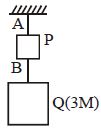
- 1Wires $A$ and $B$ are connected with blocks $P$ and $Q$ as shown. The ratio of lengths, radii and Young's modulus of wires $A$ and $B$ are $r, 2r$ and $3r$ respectively ($r$ is a constant). Find the mass of block $P$ if ratio of increase in their corresponding lengths is $1/6r^2$. The mass of block $Q$ is $3M$.View Solution
- 2A cubical solid aluminium (bulk modulus $=-V \frac{ dP }{ dV }=70 GPa$ ) block has an edge length of $1 m$ on the surface of the earth. It is kept on the floor of a $5 km$ deep ocean. Taking the average density of water and the acceleration due to gravity to be $10^3 kg m ^{-3}$ and $10 ms ^{-2}$, respectively, the change in the edge length of the block in $mm$ is . . . . .View Solution
- 3The mass and length of a wire are $M$ and $L$ respectively. The density of the material of the wire is $d$. On applying the force $F$ on the wire, the increase in length is $l$, then the Young's modulus of the material of the wire will beView Solution
- 4A steel wire of lm long and $1\,m{m^2}$ cross section area is hang from rigid end. When weight of $1\,kg$ is hung from it then change in length will be given ..... $mm$ $(Y = 2 \times {10^{11}}N/{m^2})$View Solution
- 5A stress of $1.5\,kg.wt/mm^2$ is applied to a wire of Young's modulus $5 \times 10^{11}\,N/m^2$ . The percentage increase in its length isView Solution
- 6A material has Poisson's ratio $0.50.$ If a uniform rod of it suffers a longitudinal strain of $2 \times {10^{ - 3}}$, then the percentage change in volume isView Solution
- 7View SolutionBulk modulus was first defined by
- 8A solid sphere of radius $r$ made of a soft material of bulk modulus $K$ is surrounded by a liquid in a cylindrical container. A massless piston of area $a$ floats on the surface of the liquid, covering entire crosssection of cylindrical container. When a mass $m$ is placed on the surface of the piston to compress the liquid, the fractional decrement in the radius of the sphere, $\left( {\frac{{dr}}{r}} \right)$ isView Solution
- 9View SolutionThe Bulk Modulus for an incompressible liquid is
- 10View SolutionWhen shearing force is applied on a body, then the elastic potential energy is stored in it. On removing the force, this energy