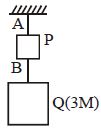
Wires $A$ and $B$ are connected with blocks $P$ and $Q$ as shown. The ratio of lengths, radii and Young's modulus of wires $A$ and $B$ are $r, 2r$ and $3r$ respectively ($r$ is a constant). Find the mass of block $P$ if ratio of increase in their corresponding lengths is $1/6r^2$. The mass of block $Q$ is $3M$.
Diffcult
Download our app for free and get started

Download our appand get started for free
Experience the future of education. Simply download our apps or reach out to us for more information. Let's shape the future of learning together!No signup needed.*
Similar Questions
- 1The pressure of a medium is changed from $1.01 × 10^5$ $Pa$ to $1.165 × 10^5$ $Pa$ and change in volume is $10\% $ keeping temperature constant. The Bulk modulus of the medium isView Solution
- 2View SolutionThe quality of the material which opposes the change in shape, volume or length is called
- 3A bob of mass $10\, kg$ is attached to wire $0.3\, m$ long. Its breaking stress is $4.8 \times 10^7 N/m^2$. The area of cross section of the wire is $10^{-6} m^2$. The maximum angular velocity with which it can be rotated in a horizontal circle ....... $rad/sec$View Solution
- 4If the compressibility of water is $\sigma $ per unit atmospheric pressure, then the decrease in volume $V$ due to $P$ atmospheric pressure will beView Solution
- 5View SolutionThe material which practically does not show elastic after effect is
- 6View SolutionLiquids have no Poisson's ratio, because
- 7A wire of cross section $4 \;mm^2$ is stretched by $0.1\, mm$ by a certain weight. How far (length) will be wire of same material and length but of area $8 \;mm^2$ stretch under the action of same force......... $mm$View Solution
- 8View SolutionIn which case there is maximum extension in the wire, if same force is applied on each wire
- 9Overall changes in volume and radii of a uniform cylindrical steel wire are $0.2 \%$ and $0.002 \%$ respectively when subjected to some suitable force. Longitudinal tensile stress acting on the wire is ($Y = 2.0 × 10^{11} Nm^{-2}$)View Solution
- 10$Assertion :$ Solids are least compressible and gases are most compressible.View Solution
$Reason :$ solids have definite shape and volume but gases do not have either definite shape or definite volume.