Question
Define gravitational potential energy of a body. Derive an expression for the gravitational potential energy of a body of mass 'm' located at a distance 'r' from the centre of the earth.

Answer

Gravitational potential energy. The work done in carrying a mass 'm' from infinity to a point at distance r is called gravitational potential energy. $\text{G.P.E.}=-\frac{\text{GMm}}{\text{r}}$i.e., G.P.E. = Mass × Gravitational potential
It is a scalar quantity measured in joule. Negative sign means that the mass is bound to M. The gravitational force of attraction between M and m when x is the distance between their centres is given by, $\text{F}=\frac{\text{GMm}}{\text{x}^2}$ Suppose the body is moved through a distance dx, therefore, work done is given by, $\text{dW}=\text{Fdx}=\frac{\text{GMm}}{\text{x}^2}\text{dx}$ When the body is brought from infinity to some distance r, We write, $\int\text{dW}=\int^\limits{\text{x}=\text{r}}_\limits{\text{x}=\infty}\frac{\text{GMm}}{\text{x}^2}\text{dx}$ $\text{or }\text{W}=\text{GMm}\Big[\frac{-1}{\text{x}}\Big]^{\text{r}}_{\infty}$ $=-\text{GMm}\Big[\frac{1}{\text{r}}-\frac{1}{\infty}\Big]=\frac{-\text{GMm}}{\text{r}}$ This amount of work done is the change in the potential energy of the body. $\therefore\text{P.E.}\text{ U }=\frac{-\text{GMm}}{\text{r}}$

Need a full question paper?

Generate a complete, print-ready paper with questions like this in minutes — across 16+ boards, with answer keys.
Start Generating Free

Similar questions

In an infinite homogeneous viscous liquid a sphere is falling. Obtain the formula for terminal velocity of the sphere.
One end of a long string of linear mass density $8.0 \times 10^{–3}kg m^{–1}$ is connected to an electrically driven tuning fork of frequency $256Hz$. The other end passes over a pulley and is tied to a pan containing a mass of $90kg$. The pulley end absorbs all the incoming energy so that reflected waves at this end have negligible amplitude. At $t = 0$, the left end (fork end) of the string $x = 0$ has zero transverse displacement $(y = 0)$ and is moving along positive y-direction. The amplitude of the wave is $5.0cm$. Write down the transverse displacement y as function of x and t that describes the wave on the string.
If the radius of the earth decreases by 1% without changing its mass, will the acceleration due to gravity at the surface of the earth increase or decrease? If so, by what per cent?
A person travelling in a fast spaceship measures the distance between the earth and the moon. Is it the same, smaller or larger than the value quoted in this book?
A charge of $1\mu\text{C}$ is given to one plate of a parallel-plate capacitor of capacitance $0.1\mu\text{F}$ and a charge of $2\mu\text{C}$ is given to the other plate. Find the potential difference developed between the plates.
A cricketer can throw a ball to a maximum horizontal distance of 100m. How much high above the ground can the cricketer throw the same ball.
Two ball bearings of mass m each moving in opposite directions with equal speed v collide head-on with each other. Predict the outcome of the collision, assuming it to be perfectly elastic.
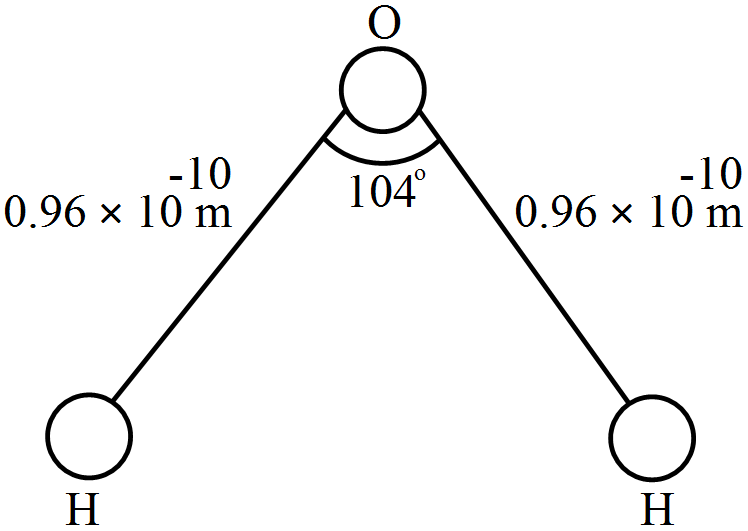
The structure of a water molecule is shown in figure. Find the distance of the centre of mass of the molecule from the centre of the oxygen atom.
A 5cm cube has its upper face displaced by 0.2cm by a tangential force of 8N. Calculate the shearing strain, shearing stress and modulus of rigidity of the material of cube.
How much energy is radiated per minute from the filament of incandescent lamp at 3000K if the surface area is $10^{-4}m^2$ and its emissivity is $0.4?$ Stefan's constant $= 5.67 \times 10^{-8} Wm^{-2}K^{-4}.$