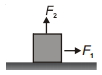
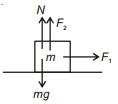
In the figure shown, horizontal force $F_1$ is applied on a block but the block does not slide. Then as the magnitude of vertical force $F_2$ is increased from zero the block begins to slide; the correct statement is
Medium


Download our appand get started for free
Experience the future of education. Simply download our apps or reach out to us for more information. Let's shape the future of learning together!No signup needed.*
Similar Questions
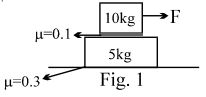
- 1The maximum $"F"$ which will not cause motion of any of the blocks. ...... $N$View Solution
- 2When a body slides down from rest along a smooth inclined plane making an angle of $30^{\circ}$ with the horizontal, it takes time $T$. When the same body slides down from the rest along a rough inclined plane making the same angle and through the same distance, it takes time $\alpha {T}$, where $\alpha$ is a constant greater than $1 .$ The co-efficient of friction between the body and the rough plane is $\frac{1}{\sqrt{{x}}}\left(\frac{\alpha^{2}-1}{\alpha^{2}}\right)$ where ${x}=..... .$View Solution
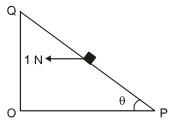
- 3A small block of mass of $0.1 \ kg$ lies on a fixed inclined plane $P Q$ which makes an angle $\theta$ with the horizontal. A horizontal force of $1 \ N$ on the block through its center of mass as shown in the figure. The block remains stationary if (take $g =10 \ m / s ^2$ ) $Image$View Solution
$(A)$ $\theta=45^{\circ}$
$(B)$ $\theta>45^{\circ}$ and a frictional force acts on the block towards $P$.
$(C)$ $\theta>45^{\circ}$ and a frictional force acts on the block towards $Q$.
$(D)$ $\theta<45^{\circ}$ and a frictional force acts on the block towards $Q$.
- 4Two bodies of equal masses revolve in circular orbits of radii ${R_1}$ and ${R_2}$ with the same period. Their centripetal forces are in the ratioView Solution
- 5A stone of mass of $16\, kg$ is attached to a string $144 \,m$ long and is whirled in a horizontal circle. The maximum tension the string can withstand is $16$ Newton. The maximum velocity of revolution that can be given to the stone without breaking it, will be ....... $ms^{-1}$View Solution
- 6View SolutionA metal block is resting on a rough wooden surface. A horizontal force applied to the block is increased uniformly. Which of the following curves correctly represents velocity of the block ?
- 7A motorcycle is going on an overbridge of radius $R$. The driver maintains a constant speed. As the motorcycle is ascending on the overbridge, the normal forces on it isView Solution
- 8A cube of mass $m$ slides down an inclined right-angle trough. If the coefficient of kinetic friction between the cube and the trough is $\mu _k$ , then the acceleration of the block isView Solution
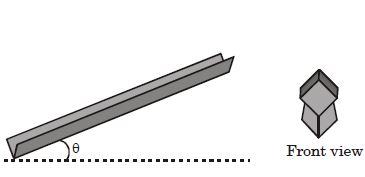
- 9A block of mass $4\, kg$ rests on an inclined plane. The inclination of the plane is gradually increased. it is found that when the inclination is $3$ in $5\left( {\sin \theta = \frac{3}{5}} \right)$, the block just begins to slide down the plane. The coefficient of friction between the block and the plane isView Solution
- 10A body of mass $40\,kg$ resting on rough horizontal surface is subjected to a force $P$ which is just enough to start the motion of the body. If $\mu_{ s }=5, \mu_{ x }=0.4$, $g =10\,m / s ^2$ and the force $P$ is continuously applied on the body, then the acceleration of the body is $.........m/s^{2}$View Solution