Question
A sample contains a mixture of $^{108}Ag$ and $^{110}Ag$ isotopes each having an activity of $8.0 \times 10^8$ disintegration per second. $^{110}Ag$ is known to have larger half-life than $^{108}Ag$. The activity A is measured as a function of time and the following data are obtained.
Time (s) Activity (A) ($10^8$ disinte- grations $s^{-1}$) Time (s) Activity (A) ($10^8$ disinte-grations $s^{-1}$)
20 11.799 200 3.0828
40 9.1680 300 1.8899
60 7.4492 400 1.1671
80 6.2684 500 0.7212
100 5.4115    
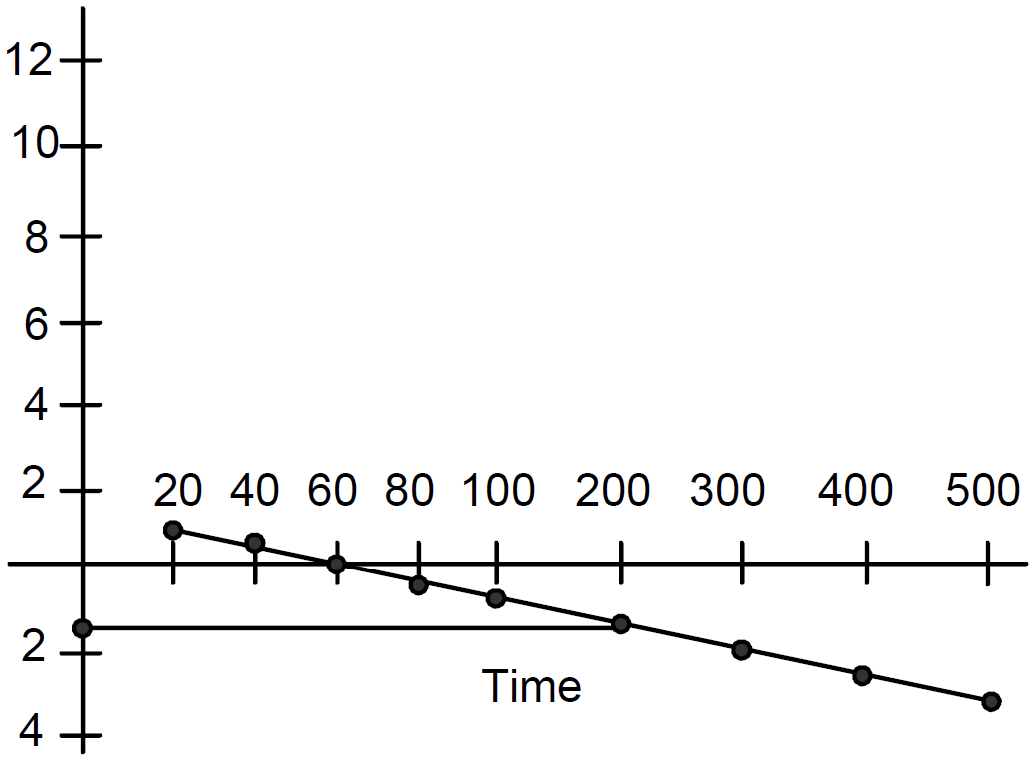
  1. Plot ln $\Big(\frac{\text{A}}{\text{A}_0}\Big)$ versus time.
  2. See that for large values of time, the plot is nearly linear. Deduce the half-life of $^{110}Ag$ from this portion of the plot.
  3. Use the half-life of $^{110}Ag$ to calculate the activity corresponding to $^{108}Ag$ in the first 50s.
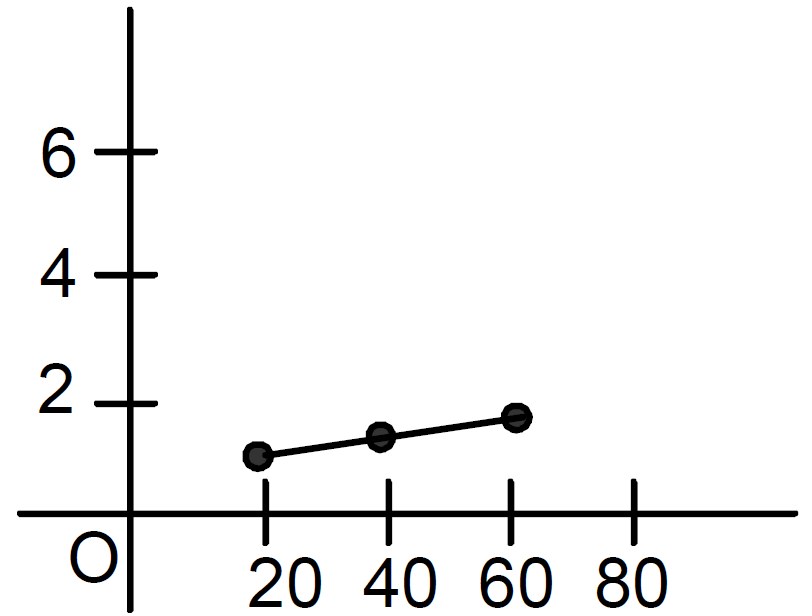
  4. Plot In $\Big(\frac{\text{A}}{\text{A}_0}\Big)$ versus time for $^{108}Ag$ for the first 50s.
  5. Find the half-life of $^{108}Ag$.

Answer

Activities of sample containing $^{108}Ag$ and $^{110}Ag$ isotopes = $8.0 \times 10^8$ disintegration/sec.
  1. Here we take A = 8 × 10⁸ dis./sec
  1. ​​​​​$\text{ln}\Big(\frac{\text{A}_1}{\text{A}_{0_{1}}}\Big)=\text{ln}\Big(\frac{11.79}{8}\Big)=0.389$
  2. $\text{ln}\Big(\frac{\text{A}_2}{\text{A}_{0_{2}}}\Big)=\text{ln}\Big(\frac{9.1680}{8}\Big)=0.1362$
  3. $\text{ln}\Big(\frac{\text{A}_3}{\text{A}_{0_{3}}}\Big)=\text{ln}\Big(\frac{7.4492}{8}\Big)=-0.072$
  4. $\text{ln}\Big(\frac{\text{A}_4}{\text{A}_{0_{4}}}\Big)=\text{ln}\Big(\frac{6.2684}{8}\Big)=-0.244$
  5. $\text{ln}\Big(\frac{5.4115}{8}\Big)=-0.391$
  6. $\text{ln}\Big(\frac{3.0828}{8}\Big)=-0.954$
  7. $\text{ln}\Big(\frac{1.8899}{8}\Big)=-1.443$
  8. $\text{ln}\Big(\frac{1.167}{8}\Big)=-1.93$
  9. $\text{ln}\Big(\frac{0.7212}{8}\Big)=-2.406$
  1. The half life of $^{110}Ag$ from this part of the plot is 24.4s.
  2. Half life of $^{110}Ag = 24.4s$.
$\therefore\text{decay constant}\lambda=\frac{0.693}{24.4}=0.0284\Rightarrow\text{t}=50\text{sec,}$
The activity $\text{A = A}_{0}\text{e}^{-\lambda\text{t}}=8\times10^8\times\text{e}^{-0.0284\times50}=1.93\times10^8$
  1.  
  1. The half life period of $^{108}Ag$ from the graph is 144s.

Need a full question paper?

Generate a complete, print-ready paper with questions like this in minutes — across 16+ boards, with answer keys.

Start Generating Free

Similar questions

The magnetic field in a region is given by $\vec{\text{B}}=\vec{\text{k}}\frac{\text{B}_0}{\text{L}}\text{y}$ where L is a fixed length. A conductihg rod of of length lies along the Y-axis between the origin and the point (0, L, 0). If the rod moves with a velocity $\text{v}=\text{v}_0\vec{\text{i}},$ find the emf induced between the ends of the rod.
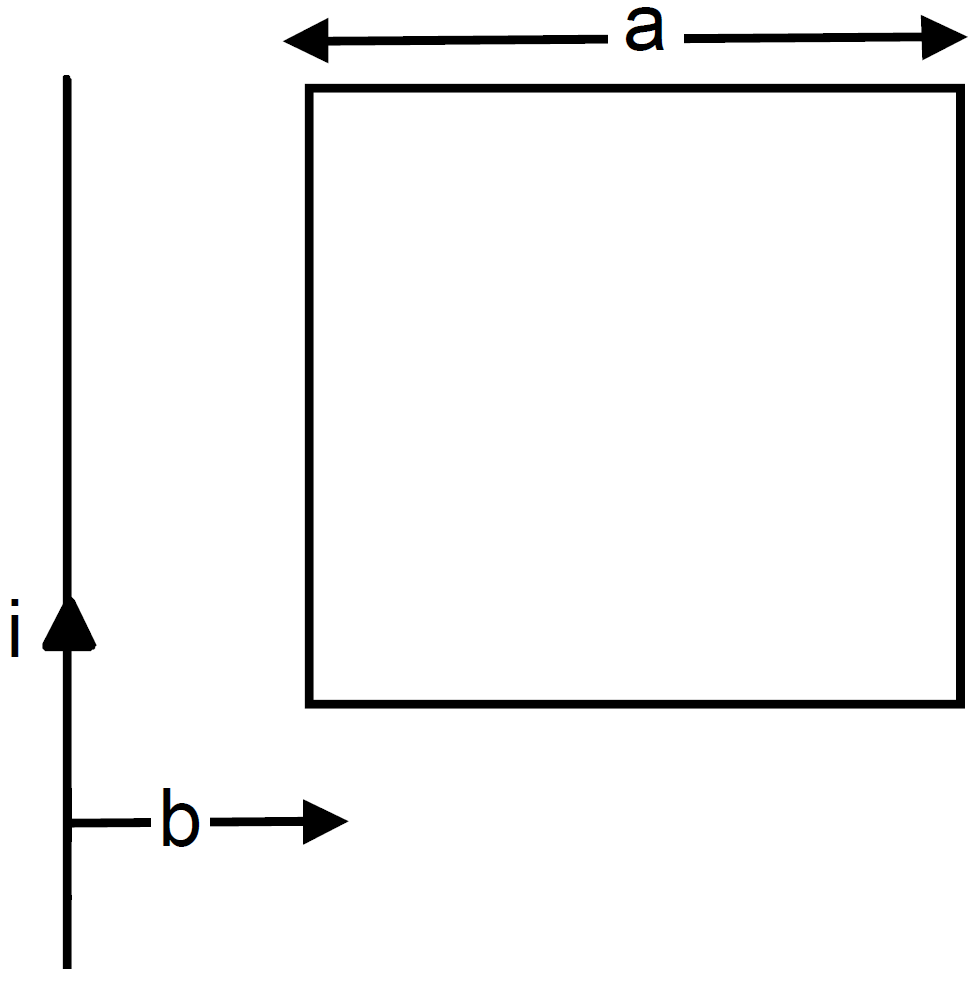
Find the mutual inductance between the straight wire and the square loop of figure.
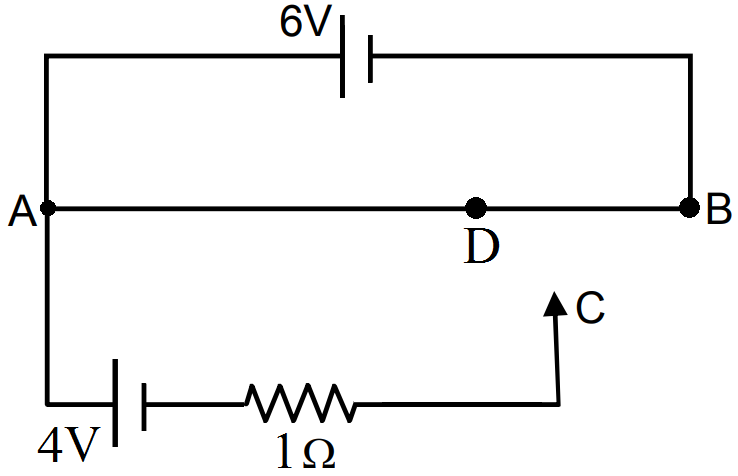
A 6 volt battery of negligible internal resistance is connected across a uniform wire AB of length $100cm$. The positive terminal of another battery of emf $4V$ and internal resistance $1\Omega$ is joined to the point A, as shown in the figure. Take the potential at B to be zero. (a) What are the potentials at the points A and C? (b) At which point D of the wire AB, the potential is equal to the potential at C? (c) If the points C and D are connected by a wire, what will be the current through it? (d) If the $4V$ battery is replaced by a $7.5V$ battery, what would be the answers of parts (a) and (b)?
A cylinder of mass $5kg$ and radius $30cm$ and free to rotate about its axis, receives an angular impulse of $3kgm^2 s^{-1}$ followed by a similar impulse after every $4$ seconds. What is the angular speed of the cylinder $30s$ after the initial impulse? The cylinder is at rest initially.
A $5mm$ high pin is placed at a distance of $15cm$ from a convex lens of focal length $10cm$. A second lens of focal length $5cm$ is placed $40cm$ from the first lens and $55cm$ from the pin. Find
  1. The position of the final image.
  2. Its nature.
  3. Its size.
Two small balls A and B, each of mass m, are joined rigidly to the ends of a light rod of lengh L (figure). The system translates on a frictionless horizontal surface with a velocity vo in a direction perpendicular to the rod. A particle P of mass m kept at rest on the surface sticks to the ball A as the ball collides with it. Find:
  1. The linear speeds of the balls A and B after the collision.
  2. The velocity of the centre of mass C of the system A + B + P.
  3. The angular speed of the system about C after the collision.
[Hint: The light rod will exert a force on the ball B only along its length.]
A gun of mass M fires a bullet of mass m with a horizontal speed V. The gun is fitted with a concave mirror of focal length f facing tpwards the receding bullet. Find the speed of separation of the bullet and the image just after the gun was fired.
A cricketer can throw a ball to a maximum horizontal distance of 100m. How much high above the ground can the cricketer throw the same ball?
Two particles each of mass m and speed v travel in opposite direction along parallel lines, separated by a distance d. Show that vector angular momentum of the two particles system is same whatever be the point about which angular momentum is taken.
Find the reading of the spring balance shown in figure. The elevator is going up with an acceleration of $\frac{\text{g}}{10},$ the pulley and the string are light and the pulley is smooth.