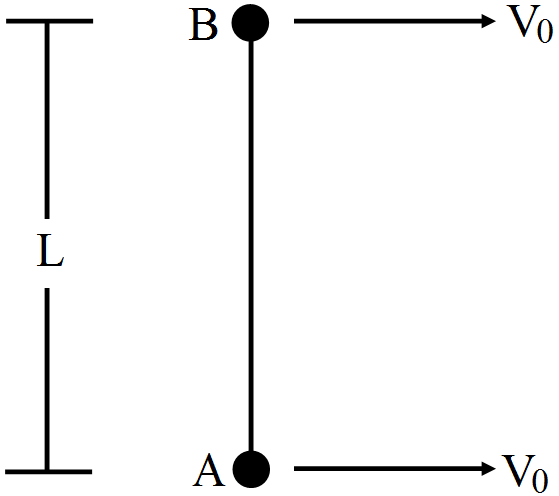
Two small balls A and B, each of mass m, are joined rigidly to the ends of a light rod of lengh L (figure). The system translates on a frictionless horizontal surface with a velocity vo in a direction perpendicular to the rod. A particle P of mass m kept at rest on the surface sticks to the ball A as the ball collides with it. Find:
- The linear speeds of the balls A and B after the collision.
- The velocity of the centre of mass C of the system A + B + P.
- The angular speed of the system about C after the collision.
Download our app for free and get started
Two balls A & B, each of mass m are joined rigidly to the ends of a light of rod of length L. The system moves in a velocity $v_0$ in a direction $\perp$ to the rod. A particle P of mass m kept at rest on the surface sticks to the ball A as the ball collides with it.
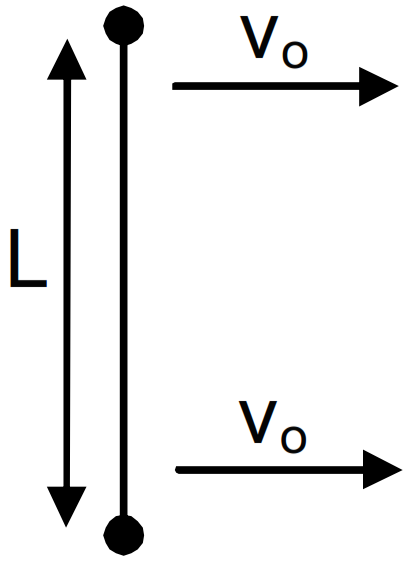
If we consider the three bodies to be a system.
Applying L.C.L.M.
Therefore $\text{mv}_0=2\text{mv}'$
$\Rightarrow\text{v}'=\frac{\text{v}_0}{2}$
Therefore a has velocity $\frac{\text{v}_0}{2}$
Therefore $\text{V}_{\text{cm}}=\frac{\text{m}\times\text{v}_0+2\text{m}\big(\frac{\text{v}_0}{2}\big)}{\text{m}+\text{2m}}$
$=\frac{\text{mv}_0+\text{mv}_0}{3\text{m}}=\frac{2\text{v}_0}{3}$ (along the initial velocity as before collision)
[Only magnitude has been taken]
Distance of the (A + P) from centre of mass $=\frac{\text{l}}3{}$ & for B it is $=\frac{2\text{l}}3{}.$
Therefore $\text{P}_\text{cm}=\text{l}_\text{cm}\times\omega$
$\Rightarrow2\text{m}\times\frac{\text{v}_0}{6}\times\frac{1}{3}+\text{m}\times\frac{\text{v}_0}{3}\times\frac{\text{2l}}{3}$
$=\text{2m}\Big(\frac{1}{3}\Big)^2+\text{m}\Big(\frac{2\text{l}}{3}\Big)^2\times\omega$
$\Rightarrow\frac{6\text{mv}_0\text{l}}{18}=\frac{\text{6ml}}{9}\times\omega$
$\Rightarrow\omega=\frac{\text{v}_0}{\text{2l}}$
- The light rod will exert a force on the ball B only along its length. So collision will not affect its velocity.
If we consider the three bodies to be a system.
Applying L.C.L.M.
Therefore $\text{mv}_0=2\text{mv}'$
$\Rightarrow\text{v}'=\frac{\text{v}_0}{2}$
Therefore a has velocity $\frac{\text{v}_0}{2}$
- if we consider the three bodies to be a system.
Therefore $\text{V}_{\text{cm}}=\frac{\text{m}\times\text{v}_0+2\text{m}\big(\frac{\text{v}_0}{2}\big)}{\text{m}+\text{2m}}$
$=\frac{\text{mv}_0+\text{mv}_0}{3\text{m}}=\frac{2\text{v}_0}{3}$ (along the initial velocity as before collision)
- The velocity of (A + P) w.r.t. the centre of mass $=\frac{2\text{v}_0}{3}-\frac{\text{v}_0}{2}=\frac{\text{v}_0}{6}$ &
[Only magnitude has been taken]
Distance of the (A + P) from centre of mass $=\frac{\text{l}}3{}$ & for B it is $=\frac{2\text{l}}3{}.$
Therefore $\text{P}_\text{cm}=\text{l}_\text{cm}\times\omega$
$\Rightarrow2\text{m}\times\frac{\text{v}_0}{6}\times\frac{1}{3}+\text{m}\times\frac{\text{v}_0}{3}\times\frac{\text{2l}}{3}$
$=\text{2m}\Big(\frac{1}{3}\Big)^2+\text{m}\Big(\frac{2\text{l}}{3}\Big)^2\times\omega$
$\Rightarrow\frac{6\text{mv}_0\text{l}}{18}=\frac{\text{6ml}}{9}\times\omega$
$\Rightarrow\omega=\frac{\text{v}_0}{\text{2l}}$

Download our appand get started for free
Experience the future of education. Simply download our apps or reach out to us for more information. Let's shape the future of learning together!No signup needed.*
Similar Questions
- 1View SolutionThree particles of masses 1.0kg, 2.0kg and 3.0kg are placed at the corners A, B and C respectively of an equilateral triangle ABC of edge 1m. Locate the centre of mass of the system.
- 2Two masses $M_1$ and $M_2$ are separated by a distance r. Find the moment of inertia of this arrangement about an axis passing through the centre of mass and perpendicular to the line joining them.View Solution
- 3View SolutionWhat do you mean by the term "equilibrium"? What are equilibrium of rest and equilibrium of motion? State the conditions for complete equilibrium of a body.
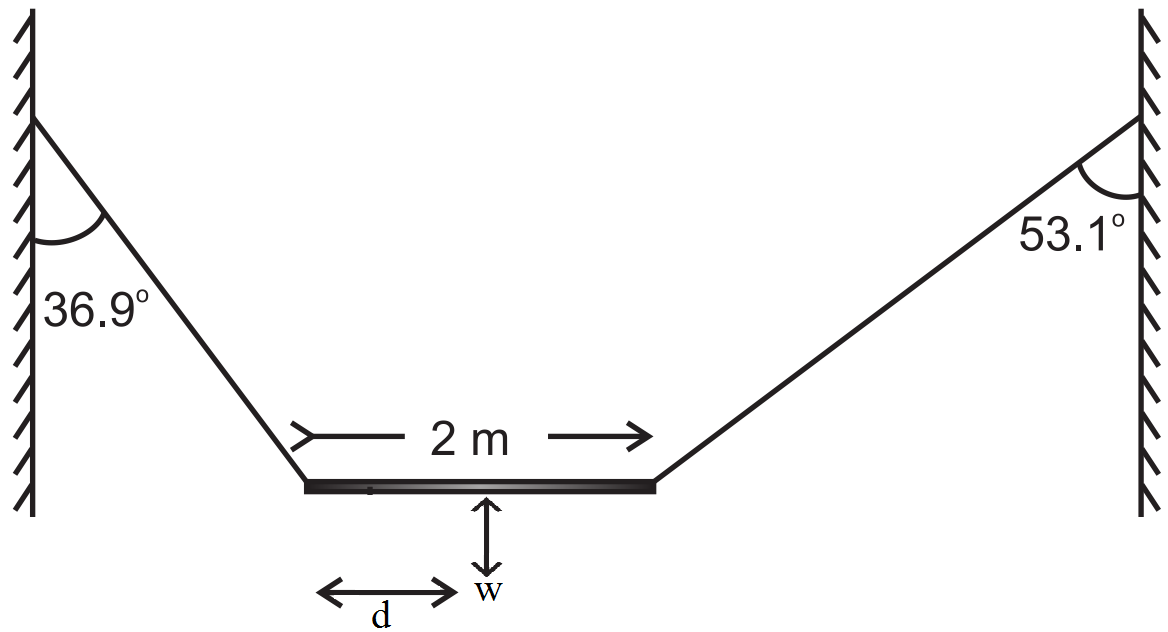
- 4A non-uniform bar of weight W is suspended at rest by two strings of negligible weight as shown in. The angles made by the strings with the vertical are $36.9°$ and $53.1°$ respectively. The bar is $2m$ long. Calculate the distance d of the centre of gravity of the bar from its left end.View Solution
- 5Separation of Motion of a system of particles into motion of the centre of mass and motion about the centre of mass: Show $\text{K}=\text{K}'+\frac{1}{2}\text{M}\text{V}^2$ where K' is the total kinetic energy of the system of particles, K′ is the total kinetic energy of the system when the particle velocities are taken with respect to the centre of mass and $\frac{\text{MV}^2}{2}$ is the kinetic energy of the translation of the system as a whole (i.e. of the centre of mass motion of the system). The result has been used in $\sec7.14$View Solution
- 6View SolutionDiscuss the rolling motion of a cylinder on an inclined plane.
- 7A uniform square plate S(side c) and a uniform rectangular plate R(sides b, a) have identical areas and masses:View Solution
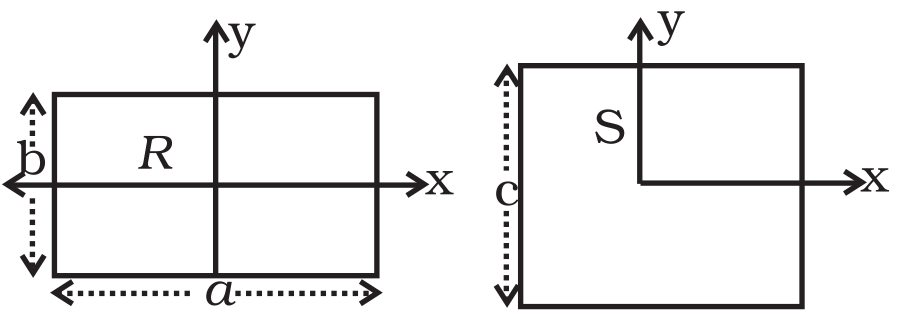
Show that:- $\frac{\text{I}_\text{xR}}{\text{I}_\text{xS}}<1$
- $\frac{\text{I}_\text{ys}}{\text{I}_\text{ys}}>1$
- $\frac{\text{I}_{2\text{R}}}{\text{I}_{2\text{s}}}>1$
- 8A disc of mass $5kg$ and radius $50cm$ rolls on the ground at the rate of $10ms^{-1}$. Calculate the K.E. of the disc. $\Big(\text{Given}:\text{I}=\frac{1}{2}\text{MR}^2\Big)$View Solution
- 9A comet revolves around the sun in a highly elliptical orbit having a minimum distance of $7 \times 10^{10}m$ and a maximum distance of $1.4 \times 10^{13}m$. If its speed while nearest to the Sun is $60km s^{-1}$, find its linear speed when situated farthest from the Sun.View Solution
- 10Two discs of moments of inertia $I_1$ and $I_2$ about their respective axes (normal to the disc and passing through the centre), and rotating with angular speeds $\omega_1$ and $\omega_2$ are brought into contact face to face with their axes of rotation coincident.View Solution
- What is the angular speed of the two-disc system?
- Show that the kinetic energy of the combined system is less than the sum of the initial kinetic energies of the two discs. How do you account for this loss in energy? Take $\omega_1\neq\omega_2$