A cylinder of mass $5kg$ and radius $30cm$ and free to rotate about its axis, receives an angular impulse of $3kgm^2 s^{-1}$ followed by a similar impulse after every $4$ seconds. What is the angular speed of the cylinder $30s$ after the initial impulse? The cylinder is at rest initially.
Download our app for free and get started
$m = 5kg, r = 30 \times 10^{-2}m, dL = 3kgm^2s^{-1}, t = 4 sec$.
Angular Impulse = dL = 3
We know, $\text{L}=\text{I}\omega$
$\therefore\text{dL}=3=\text{I}(\omega_{\text{f}}-\omega_{\text{i}})=\frac{1}{2}\text{mr}^2(\omega_{\text{f}-\omega_{\text{i}}})$
$3=\frac{1}{2}\times5\times(0.30)^2\times(\omega-0)$
Solving, $\omega=\frac{40}{3}\text{ rads}^{-1}$
Using $\omega=\omega_{\text{i}}+\alpha\text{t},\text{ we get}$
$\frac{40}{3}=0+\alpha(4)(\text{i.e.,})\alpha=\frac{10}{3}\text{ rads}^{-1}$
Since time gap between impulse acting is 4s, the impulse will go up to 32 s
$\therefore\omega=\omega_{\text{i}}+\alpha\text{t}=0\frac{10}{3}\times32=106.67\text{ rads}^{-1}$
Angular Impulse = dL = 3
We know, $\text{L}=\text{I}\omega$
$\therefore\text{dL}=3=\text{I}(\omega_{\text{f}}-\omega_{\text{i}})=\frac{1}{2}\text{mr}^2(\omega_{\text{f}-\omega_{\text{i}}})$
$3=\frac{1}{2}\times5\times(0.30)^2\times(\omega-0)$
Solving, $\omega=\frac{40}{3}\text{ rads}^{-1}$
Using $\omega=\omega_{\text{i}}+\alpha\text{t},\text{ we get}$
$\frac{40}{3}=0+\alpha(4)(\text{i.e.,})\alpha=\frac{10}{3}\text{ rads}^{-1}$
Since time gap between impulse acting is 4s, the impulse will go up to 32 s
$\therefore\omega=\omega_{\text{i}}+\alpha\text{t}=0\frac{10}{3}\times32=106.67\text{ rads}^{-1}$

Download our appand get started for free
Experience the future of education. Simply download our apps or reach out to us for more information. Let's shape the future of learning together!No signup needed.*
Similar Questions
- 1Two cylindrical hollow drums of radii R and 2R, and of a common height h, are rotating with angular velocities $\omega$ (anti-clockwise) and $\omega$ (clockwise), respectively. Their axes, fixed are parallel and in a horizontal plane separated by $(3\text{R}+\delta).$ They are now brought in contact $(\delta\rightarrow0){:}$View Solution
- Show the frictional forces just after contact.
- Identify forces and torques external to the system just after contact.
- What would be the ratio of final angular velocities when friction ceases?
- 2Two particles of mass $2kg$ and $1kg$ are moving along the same line with speeds $2ms-1$ and $5ms^{-1}$ respectively. What is the speed of the centre of mass of the system if both the particles are moving (a) in same direction (b) in opposite direction?View Solution
- 3Prove that the velocity v of translation of a rolling body (like a ring, disc, cylinder or sphere) at the bottom of an inclined plane of height h is given by:$\text{v}^2=\frac{2\text{gh}}{\big(1+\frac{\text{K}^2}{\text{R}^2}\big)}$View Solution
Note K is the radius of gyration of the body about its symmetry axis, and R is the radius of the body. The body starts from rest at the top of the plane. - 4The angular speed of a motor wheel is increased from $1200$ rpm to $3120$ rpm in $16$ seconds. $(i)$ What is its angular acceleration, assuming the acceleration to be uniform? $(ii)$ How many revolutions does the engine make during this time?View Solution
- 5View SolutionShow that a(b × c) is equal in magnitude to the volume of the parallelepiped formed on the three vectors a, b and c.
- 6View SolutionA uniform disc of radius R is put over another uniform disc of radius 2R of the same thickness and density. The peripheries of the two discs touch each other. Locate the centre of mass of the system.
- 7Calculate the angular momentum and rotational kinetic energy of earth about its own axis. How long could this amount of energy supply one kilowatt power to each of the $3.5 \times 10^9$ persons on earth? (Mass of earth = $6.0 \times 1024kg$ and radius = $6.4 \times 10^{24}km)$.View Solution
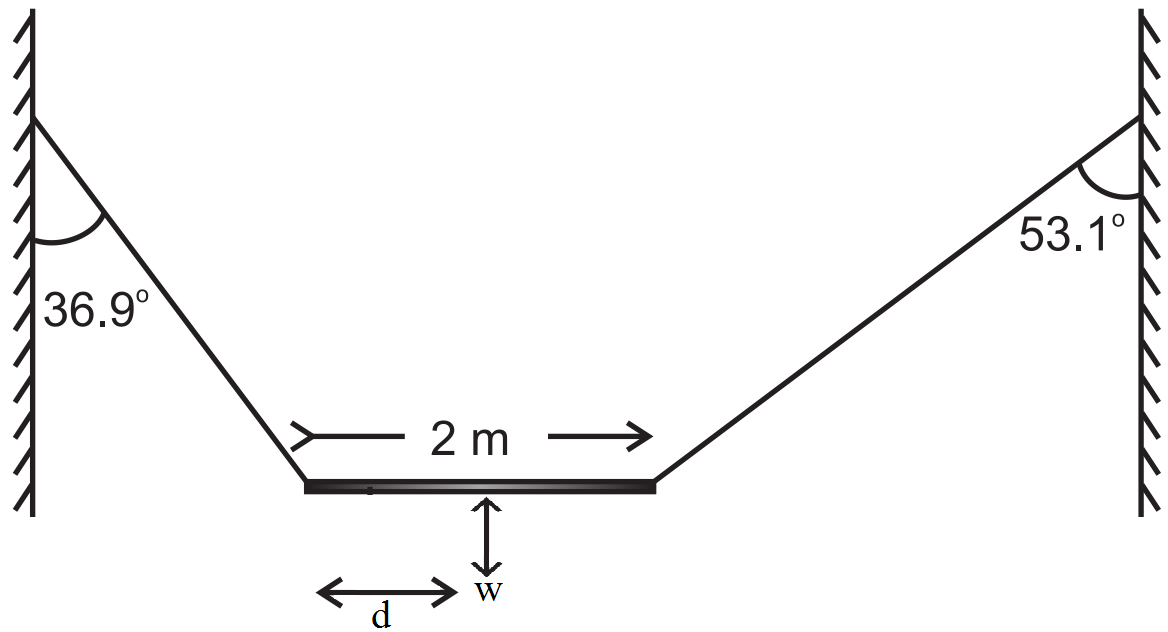
- 8A non-uniform bar of weight W is suspended at rest by two strings of negligible weight as shown in. The angles made by the strings with the vertical are $36.9°$ and $53.1°$ respectively. The bar is $2m$ long. Calculate the distance d of the centre of gravity of the bar from its left end.View Solution
- 9An electron of mass $9 \times 10^{-31}kg$ revolves in a circle of radius $0.53\mathring{\text{A}}$ around the nucleus of hydrogen with a velocity of $2.2 \times 10^6ms$. Show that angular momentum of elect ron is $\frac{\text{h}}{2\pi}$ where h is Planck's constant.View Solution
- 10A disc of radius R is rotating with an angular speed $\omega_\text{o}$ about a horizontal axis. It is placed on a horizontal table. The coefficient of kinetic friction is $\mu_\text{k}{:}$View Solution
- What was the velocity of its centre of mass before being brought in contact with the table?
- What happens to the linear velocity of a point on its rim when placed in contact with the table?
- What happens to the linear speed of the centre of mass when disc is placed in contact with the table?
- Which force is responsible for the effects in (b) and (c).
- What condition should be satisfied for rolling to begin?
- Calculate the time taken for the rolling to begin.