Question
A square loop PQRS carrying a current of 6.0A is placed near a long wire carrying 10A as shown in figure.
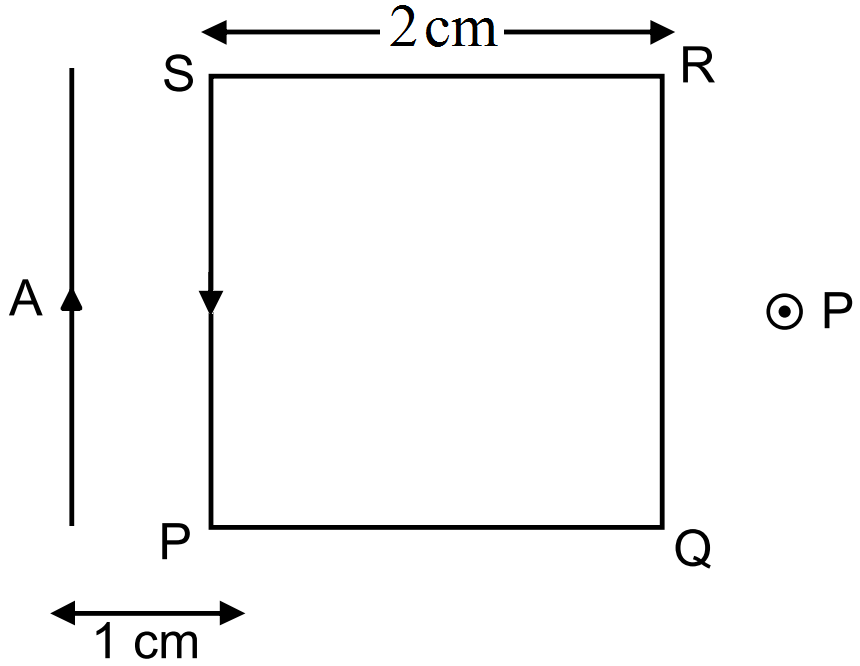
  1. Show that the magnetic force acting on the part PQ is equal and opposite to that on the part RS.
  2. Find the magnetic force on the square loop.
Answer


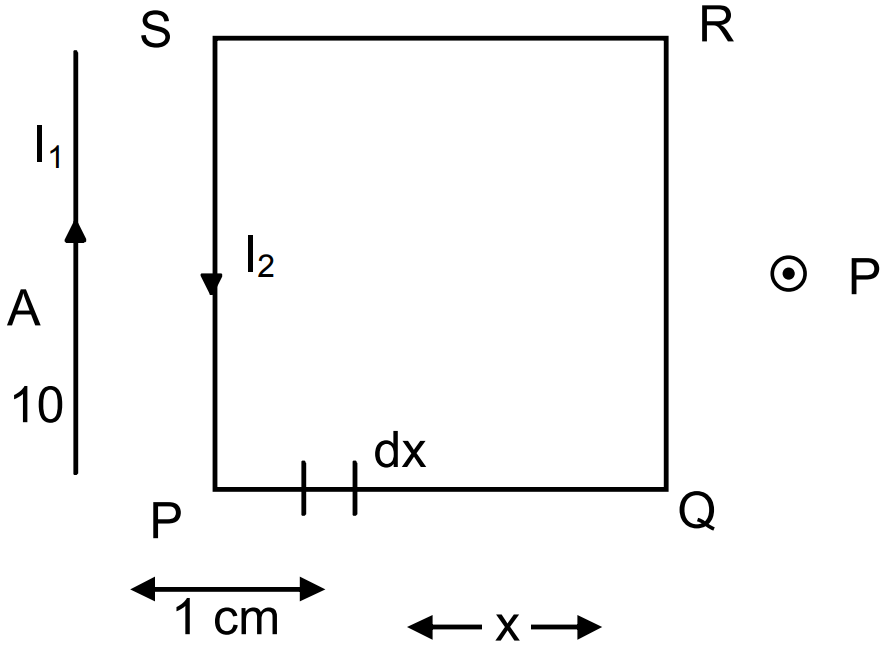
$\text{I}_2=6\text{A},\ \text{I}_1=10\text{A}$
  1. $\text{F}_\text{PQ}$
‘F’ on $=\frac{\mu_0\times30}{\text{x}}\int_1\frac{\text{dx}}{\text{x}}=30\times4\times10^{-7}\times[\log\text{x}]^2_1$
$=120\times10^{-7}[\log3-\log1]$
Similarly force of $\overrightarrow{\text{F}}_\text{RS}=120\times10^{-7}[\log3-\log1]$
  1. So, $\overrightarrow{\text{F}}_\text{PQ}=\overrightarrow{\text{F}}_\text{RS}$
$\overrightarrow{\text{F}}_\text{PS}=\frac{\mu_0\times\text{i}_1\text{i}_2}{2\pi\times1\times10^{-2}}-\frac{\mu_0\times\text{i}_1\text{i}_2}{2\pi\times2\times10^{-32}}$
$=\frac{2\times6\times10\times10^{-7}}{10^{-2}}-\frac{2\times10^{-7}\times6\times6}{2\times10^{-2}}=8.4\times10^{-4}\text{N}$ (Towards right)
$\overrightarrow{\text{F}}_\text{RQ}=\frac{\mu_0\times\text{i}_1\text{i}_2}{2\pi\times3\times10^{-2}}-\frac{\mu_0\times\text{i}_1\text{i}_2}{2\pi\times2\times10^{-32}}$
$=\frac{4\pi\times10^{-7}\times6\times10^{-2}}{2\pi3\times10^{-2}}-\frac{4\pi\times10^{-7}\times6\times6}{2\pi\times2\times10^{-2}}$
$=4\times10^{-4}+36\times10^{-5}=7.6\times10^{-4}\text{N}$
Net force towards down
$= (8.4 + 7.6) × 10^{-4} = 16 × 10^{-4} \text{N}$

Need a full question paper?

Generate a complete, print-ready paper with questions like this in minutes — across 16+ boards, with answer keys.

Start Generating Free

Similar questions

A physical quantity X is related to four measurable quantities a, b, c and d as follows:$\text{X}=\text{a}^2\text{b}^3\text{c}^\frac{5}{2}\text{d}^{-2}.$
The percentage error in the measurement of a, b, c and d are 1%, 2%, 3% and 4%, respectively. What is the percentage error in quantity X? If the value of X calculated on the basis of the above relation is 2.763, to what value should you round off the result.
It is required to find the volume of a rectangular block. A Vernier Caliper is used to measure the length, width and height of the block. The measured values are found to be 1.37cm, 4.11cm and 2.56cm respectively.
A gaseous mixture contains $16g$ of helium and $16g$ of oxygen, then calculate the ratio of $\frac{\text{C}_{\text{p}}}{\text{C}_{\text{V}}}$ of the mixture.
A sample contains a mixture of $^{108}Ag$ and $^{110}Ag$ isotopes each having an activity of $8.0 \times 10^8$ disintegration per second. $^{110}Ag$ is known to have larger half-life than $^{108}Ag$. The activity A is measured as a function of time and the following data are obtained.
Time (s) Activity (A) ($10^8$ disinte- grations $s^{-1}$) Time (s) Activity (A) ($10^8$ disinte-grations $s^{-1}$)
20 11.799 200 3.0828
40 9.1680 300 1.8899
60 7.4492 400 1.1671
80 6.2684 500 0.7212
100 5.4115    
  1. Plot ln $\Big(\frac{\text{A}}{\text{A}_0}\Big)$ versus time.
  2. See that for large values of time, the plot is nearly linear. Deduce the half-life of $^{110}Ag$ from this portion of the plot.
  3. Use the half-life of $^{110}Ag$ to calculate the activity corresponding to $^{108}Ag$ in the first 50s.
  4. Plot In $\Big(\frac{\text{A}}{\text{A}_0}\Big)$ versus time for $^{108}Ag$ for the first 50s.
  5. Find the half-life of $^{108}Ag$.
Answer the following:
What is the temperature of the triple-point of water on an absolute scale whose unit interval size is equal to that of the Fahrenheit scale?
Find at what temperature the velocity of sound is air will be $1\frac{1}{2}$ times the velocity at 11°C.
Explain the concept of potential energy.
A solid sphere rolls down two different inclined planes of the same heights but different angles of inclination.
  1. Will it reach the bottom with the same speed in each case?
  2. Will it take longer to roll down one plane than the other?
  3. If so, which one and why?
For the wave on a string described in Exercise 15.11, do all the points on the string oscillate with the same,
  1. Frequency,
  2. Phase,
  3. Amplitude?
A large steel wheel is to be fitted on to a shaft of the same material. At $27^{\circ} C$, the outer diameter of the shaft is $8.70 \ cm$ and the diameter of the central hole in the wheel is $8.69 \ cm$ . The shaft is cooled using 'dry ice'. At what temperature of the shaft does the wheel slip on the shaft? Assume coefficient of linear expansion of the steel to be constant over the required temperature range: asteel $= 1.20 \times 10^{–5} K^{–1}.$