A scientist performs an experiment in order to measure a certain physical quantity and takes $100$ observations. He repeats the same experiment and takes $400$ observations. By doing so,
Easy


Download our appand get started for free
Experience the future of education. Simply download our apps or reach out to us for more information. Let's shape the future of learning together!No signup needed.*
Similar Questions
- 1Force $(F)$ and density $(d)$ are related as $F\, = \,\frac{\alpha }{{\beta \, + \,\sqrt d }}$ then dimension of $\alpha $ areView Solution
- 2View SolutionThe damping force on an oscillator is directly proportional to the velocity.The units of the constant of proportionality are
- 3If a copper wire is stretched to make its radius decrease by $0.1\%$ , then percentage increase in resistance is approximately .......... $\%$View Solution
- 4In a screw gauge, $5$ complete rotations of the screw cause it to move a linear distance of $0.25\, cm$. There are $100$ circular scale divisions. The thickness of a wire measured by this screw gauge gives a reading of $4$ main scale divisions and $30$ circular scale divisions . Assuming negligible zero error, the thickness of the wire isView Solution
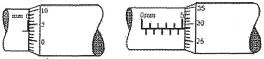
- 5Diagrams show readings of a screw gauge. figure $(i)$ shows the zero error reading when the screw gauge is closed, figure $(ii)$ the reading when the screw gauge is being used to measure the diameter of a ball-bearing. What is the diameter of the ball-bearing in $mm$? There are $50$ divisions on circular scaleView Solution
- 6View SolutionWhich relation is wrong
- 7A body travels uniformly a distance of $ (13.8 \pm 0.2) m$ in a time $(4.0 \pm 0.3)\, s$. The velocity of the body within error limits isView Solution
- 8The length of a rod is $(11.05 ± 0.05)\, cm$. What is the length of two rods ?View Solution
- 9If the constant of gravitation $(G)$, Planck's constant $(h)$ and the velocity of light $(c)$ be chosen as fundamental units. The dimension of the radius of gyration isView Solution
- 10In an experiment the angles are required to be measured using an instrument, $29$ divisions of the main scale exactly coincide with the $30$ divisions of the vernier scale. If the smallest division of the main scale is half- a degree $(= 0.5^o )$, then the least count of the instrument isView Solution