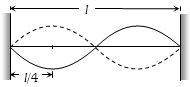
A second harmonic has to be generated in a string of length $l$ stretched between two rigid supports. The point where the string has to be plucked and touched are
Medium
Download our app for free and get started
(a) Second harmonic means $2$ loops in a total length
Hence plucking distance from one end $ = \frac{l}{{2p}} = \frac{l}{{2 \times 2}} = \frac{l}{4}.$
Download our app
and get started for free
Experience the future of education. Simply download our apps or reach out to us for more information. Let's shape the future of learning together!No signup needed.*
The figure represents the instantaneous picture of a transverse harmonic wave traveling along the negative $x$-axis. Choose the correct alternative $(s)$ related to the movement of the nine points shown in the figure. The points moving upward is/are
A closed and an open organ pipe have same lengths. If the ratio of frequencies of their seventh overtones is $\left(\frac{a-1}{a}\right)$ then the value of $a$ is
If speed of sound in air in $330 \,m / s$ then, find the number of tones present in an open organ pipe of length $1\, m$ whose frequency if $\leq 1000$.
A wire is stretched between two rigid supports vibrates in its fundamental mode with a frequency of $50\,\, Hz$ . The mass of the wire is $30\,\, g$ and its linear density is $4\, \times \, 10^{-2}\,\, kg/m$ . The speed of the transverse wave at the string is ...... $ms^{-1}$
In an experiment with sonometer when a mass of $180\,g$ is attached to the string, it vibrates with fundamental frequency of $30\,Hz$. When a mass $m$ is attached, the string vibrates with fundamental frequency of $50\,Hz$. The value of $m$ is $.........\,g$.
A wire of $9.8 \times {10^{ - 3}}kg{m^{ - 1}}$ passes over a frictionless light pulley fixed on the top of a frictionless inclined plane which makes an angle of $30°$ with the horizontal. Masses $m$ and $M$ are tied at the two ends of wire such that $m$ rests on the plane and $M$ hangs freely vertically downwards. The entire system is in equilibrium and a transverse wave propagates along the wire with a velocity of $100 ms^{-1}$. Chose the correct option $m =$ ..... $kg$
A transverse wave is represented by $y=2 \sin$ $(\omega t - kx ) cm$. The value of wavelength (in $cm$ ) for which the wave velocity becomes equal to the maximum particle velocity, will be.