MCQ
A seconds pendulum clock has a steel wire. The clock shows correct time at $25^{\circ} C$. .......... $s$ time does the clock lose or gain, in one week, when the temperature is increased to $35^{\circ} C$ ? $\left(\alpha_{\text {toel }}=1.2 \times 10^{-5} /{ }^{\circ} C \right)$
  • A
    $321.5$
  • B
    $3.828$
  • C
    $82.35$
  • $36.28$

Answer

Correct option: D.
$36.28$
d
(d)

$\frac{\Delta T}{T}=\frac{1}{2} \alpha \theta$

$=\frac{1}{2} \times 1.2 \times 10^{-5} \times 10$

$\frac{\Delta T}{T}=6.0 \times 10^{-5}$

$\text { Hence time lost in } 1 \text { week }=6.0 \times 10^{-5} \times T$

$=6.0 \times 10^{-5} \times 7 \times 24 \times 3600$

$=36.28 \,s$

Need a full question paper?

Generate a complete, print-ready paper with questions like this in minutes — across 16+ boards, with answer keys.

Start Generating Free

Similar questions

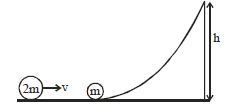
A ball of mass $2\,m$ is moving with velocity $v$ on a smooth surface collides elastically headon with another ball of mass $m$. If ball of mass $m$ reaches upto top of frictionless elevated plane, then velocity $v$ of heavy ball must be
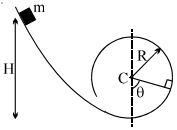
$A$ particle of mass $m$ is released from $a$ height $H$ on $a$ smooth curved surface which ends into a vertical loop of radius $R$, as shown If $\theta$ is instantaneous angle which the line joining the particle and the centre of the loop makes with the vertical, then identify the correct statement $(s)$ related to the normal reaction $N$ between the block and the surface
When two tuning forks (fork $1$ and fork $2$) are sounded simultaneously, $4$ beats per second are heard. Now, some tape is attached on the prong of the fork $2$. When the tuning forks are sounded again, $6$ beats per second are heard. If the frequency of fork $1$ is $200\, Hz$, then what was the original frequency of fork $2$? .... $Hz$
The distance $s$ travelled by a particle in time $t$ is $s=u t-\frac{1}{2} \,g t^{2}$. The initial velocity of the particle was measured to be $u=1.11 \pm 0.01 \,m / s$ and the time interval of the experiment was $t=1.01 \pm 0.1 \,s$. The acceleration was taken to be $g=9.8 \pm 0.1 \,m / s ^{2}$. With these measurements, the student estimates the total distance travelled. How should the student report the result?
The slopes of isothermal and adiabatic curves are related as
If a vector $\overrightarrow P $ making angles $\alpha, \beta\  and\ \gamma$ respectively with the $X, Y$ and $Z$ axes respectively. Then ${\sin ^2}\alpha + {\sin ^2}\beta + {\sin ^2}\gamma = $
A fighter jet is flying horizontally at a certain altitude with a speed of $200 \; ms ^{-1}$. When it passes directly overhead an anti-aircraft gun, bullet is fired from the gun, at an angle $\theta$ with the horizontal, to hit the jet. If the bullet speed is $400 \; m / s$, the value of $\theta$ will be $\dots \; {}^o$
A car weighs  $1800\,\,kg$ . The distance between its front and back axles is  $1.8\,\,m$ . Its centre of gravity is $1.05\,\,m$  behind the front axle. Force exerted by the level ground on each front wheel is ........ $N.$
At constant volume, temperature is increased. Then
A man standing on a road hold his umbrella at $30^° $ with the vertical to keep the rain away. He throws the umbrella and starts running at $10\, km/hr$. He finds that raindrops are hitting his head vertically, the speed of raindrops w.r.t. the moving man, will be