MCQ
At constant volume, temperature is increased. Then
  • A
    Collision on walls will be less
  • Number of collisions per unit time will increase
  • C
    Collisions will be in straight lines
  • D
    Collisions will not change

Answer

Correct option: B.
Number of collisions per unit time will increase
b
As the temperature increases, the average velocity of the molecules will increase, resulting in faster collisions.

Need a full question paper?

Generate a complete, print-ready paper with questions like this in minutes — across 16+ boards, with answer keys.

Start Generating Free

Similar questions

The conversion of $1 \;MW$ power in a new system having basic unit of mass, length and time as $10 \;kg , 1 \;dm$ and $1 \;minute$ respectively is:
The maximum percentage errors in the measurement of mass (M), radius (R) and angular velocity $(\omega)$ of a ring are $2 \%, 1 \%$ and $1 \%$ respectively, then find the maximum percenta? error in the measurement of its rotational kinetic energy $\left(K=\frac{1}{2} I \omega^{2}\right)$
Consider a thin square plate floating on a viscous liquid in a large tank. The height $h$ of the liquid in the tank is much less than the width of the tank. The floating plate is pulled horizontally with a constant velocity $u_0$. Which of the following statements is (are) true?

$(A)$ The resistive force of liquid on the plate is inversely proportional to $h$

$(B)$ The resistive force of liquid on the plate is independent of the area of the plate

$(C)$ The tangential (shear) stress on the floor of the tank increases with $u _0$

$(D)$ The tangential (shear) stress on the plate varies linearly with the viscosity $\eta$ of the liquid
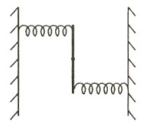
A uniform rod of length $L$ and mass $M$ is pivoted at the centre. Its two ends are attached to two springs of equal spring constants $k$. The springs are fixed to rigid supports as shown in the figure, and the rod is free to oscillate in the horizontal plane. The rod is gently pushed through a small angle $\theta$ in one direction and released. The frequency of oscillation is
A force $\text{F}=5\hat{\text{i}}+6\hat{\text{j}}-4\hat{\text{k}}$ acting on a body produces a displacement $\text{s}=6\hat{\text{i}}+5\hat{\text{k}}$ The work done by the force is:
The distance between centre of the earth and moon is $384000\, km$. If the mass of the earth is $6 \times {10^{24}}kg$ and $G = 6.66 \times {10^{ - 11}}\,N{m^2}/k{g^2}$. The speed of the moon is nearly......... $km/sec$
Two wires of equal lengths are made of the same material. Wire $A$ has a diameter that is twice as that of wire $B$. If identical weights are suspended from the ends of these wires, the increase in length is
Efficiency of engine is $\eta_1$ at $T_1 = 200^\circ C$ and $T_2 = 0^\circ C$ and $\eta_2$ at $T_1 = 0^\circ C$ and $T_2 = 200^\circ K.$ Find the ratio of $\frac{\eta_1}{\eta_2}.$
A body of mass $5\ kg$ undergoes a change in speed from $30$ to $40\ m/ s.$ Its momentum would increase by:
The maximum range of a gun on horizontal terrain is $16 \,km$. If $g = \;10m/{s^2}$. What must be the muzzle velocity of the shell ......... $m/s$