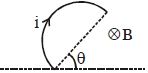
A semicircular ring of radius $R$ carrying current $i$ is placed in a magnetic field of intensity $B$ so that plane of wire is perpendicular to magnetic field as shown. Net force acting on the ring is
Easy


Download our appand get started for free
Experience the future of education. Simply download our apps or reach out to us for more information. Let's shape the future of learning together!No signup needed.*
Similar Questions
- 1An electron is moving along $+x$ direction with a velocity of $6 \times 10^{6}\, ms ^{-1}$. It enters a region of uniform electric field of $300 \,V / cm$ pointing along $+ y$ direction. The magnitude and direction of the magnetic field set up in this region such that the electron keeps moving along the $x$ direction will beView Solution
- 2View SolutionAn electron moves along vertical line and away from the observer, then pattern of concentric circular magnetic field lines which are produced due to its motion
- 3A rectangular coil $20\,cm \times 20\,cm$ has $100$ $turns$ and carries a current of $1\, A$. It is placed in a uniform magnetic field $B =0.5\, T$ with the direction of magnetic field parallel to the plane of the coil. The magnitude of the torque required to hold this coil in this position is........$N-m$View Solution
- 4A teacher in his physics laboratory allotted an experiment to determine the resistance $(G)$ of a galvanometer. Students took the observations for $\frac{1}{3}$ deflection in the galvanometer. Which of the below is true for measuring value of $G$ $?$View Solution
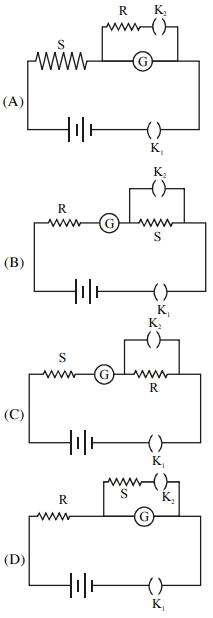
- 5In the circuit diagrams $(A, B, C$ and $D$) shown below, $R$ is a high resistance and $S$ is a resistance of the order of galvanometer resistance $G$. The correct circuit, corresponding to the half deflection method for finding the resistance and figure of merit of the galvanometer, is the circuit labelled asView Solution
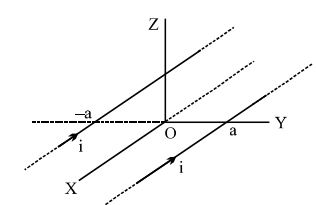
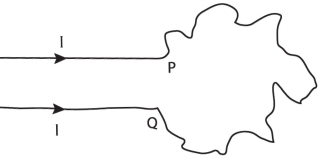
- 6Assertion $(A):$ A wire bent into an irregular shape with the points $P$ and $Q$ fixed. If a current $I$ passed through the wire, then the area enclosed by the irregular portion of the wire increases.View Solution
Reason $(R):$ Opposite currents carrying wires repel each other.
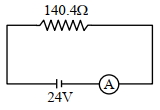
- 7In the given figure an ammeter $A$ consists of a $240 \Omega$ coil connected in parallel to a $10 \Omega$ shunt. The reading of the ammeter is . . . . . . $\mathrm{mA}$.View Solution
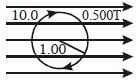
- 8A single circular loop of radius $1.00\, m$ carries a current of $10.0\, mA$. It is placed in $a$ uniform magnetic field of magnitude $0.500\, T$ that is directed parallel to the plane of the loop as suggested in the figure. The magnitude of the torque exerted on the loop by the magnetic field is.View Solution
- 9A particle of mass $M$ and charge $Q$ moving with velocity $\mathop v\limits^ \to $ describes a circular path of radius $R$ when subjected to a uniform transverse magnetic field of induction $B$. The work done by the field when the particle completes one full circle isView Solution
- 10Two long thin, parallel conductors carrying equal currents in the same direction are fixed parallel to the $x$-axis, one passing through $y = a$ and the other through $y = -a$. The resultant magnetic field due to the two conductors at any point is $B$. Which of the following are correct?View Solution