A particle of mass $M$ and charge $Q$ moving with velocity $\mathop v\limits^ \to $ describes a circular path of radius $R$ when subjected to a uniform transverse magnetic field of induction $B$. The work done by the field when the particle completes one full circle is
AIEEE 2003, Easy
Download our app for free and get started
(c) $W = F.d\cos {90^o} = 0$

Download our appand get started for free
Experience the future of education. Simply download our apps or reach out to us for more information. Let's shape the future of learning together!No signup needed.*
Similar Questions
- 1An electron has mass $9 \times {10^{ - 31}}\,kg$ and charge $1.6 \times {10^{ - 19}}C$ is moving with a velocity of ${10^6}\,m/s$, enters a region where magnetic field exists. If it describes a circle of radius $0.10\, m$, the intensity of magnetic field must beView Solution
- 2If number of turns, area and current through a coil is given by $N, A$ and $I$ respectively then its magnetic moment will beView Solution
- 3In a uniform magnetic field of $0.049 \mathrm{~T}$, a magnetic needle performs $20$ complete oscillations in $5$ seconds as shown. The moment of inertia of the needle is $9.8 \times 10^{-5} \mathrm{~kg} \mathrm{~m}^2$. If the magnitude of magnetic moment of the needle is $x \times 10^{-5} \mathrm{Am}^2$, then the value of ' $x$ ' is :View Solution
- 4In the hydrogen atom, the electron is making $6.6 \times {10^{15}}\,r.p.s.$ If the radius of the orbit is $0.53 \times {10^{ - 10}}\,metre,$ then magnetic field produced at the centre of the orbit is......$Tesla$View Solution
- 5A charge $q$ is spread uniformly over an insulated loop of radius $r$ . If it is rotated with an angular velocity $\omega $ with respect to normal axis then the magnetic moment of the loop isView Solution
- 6If a wire of length $1\, meter$ placed in uniform magnetic field $1.5\, Tesla$ at angle ${30^o}$ with magnetic field. The current in a wire $10\, amp$. Then force on a wire will be.......$N$View Solution
- 7View SolutionA magnetic field
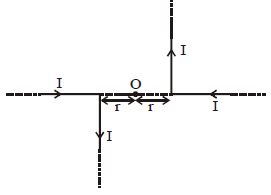
- 8Two infinite wires bent in the form of $L$ shape carries current $I$ as shown. What is magnetic field at $O$ ?View Solution
- 9Find the magnetic field at point $P$ due to a straight line segment $AB$ of length $6\, cm$ carrying a current of $5\, A$. (See figure) $(\mu _0 = 4p\times10^{-7}\, N-A^{-2})$View Solution
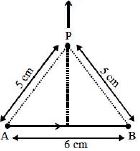
- 10Currents of a $10\, ampere$ and $2\, ampere$ are passed through two parallel thin wires $A$ and $B$ respectively in opposite directions. Wire $A$ is infinitely long and the length of the wire $B$ is $2\, m$. The force acting on the conductor $B$, which is situated at $10\, cm$ distance from $A$ will beView Solution