Question
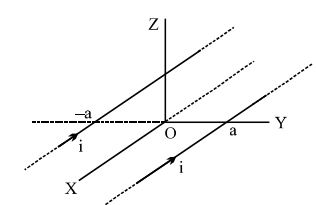
Two long thin, parallel conductors carrying equal currents in the same direction are fixed parallel to the $x$-axis, one passing through $y = a$ and the other through $y = -a$. The resultant magnetic field due to the two conductors at any point is $B$. Which of the following are correct?
Answer

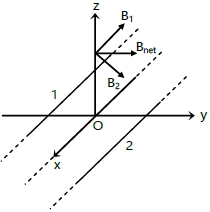
$(A)$ $\mathrm{B}=\frac{\mu_{0} \mathrm{I}}{2 \pi \mathrm{a}}-\frac{\mu_{0} \mathrm{I}}{2 \pi \mathrm{a}}=0$

$(B)$ On $y-axis$ say at $(y, 0,0)$

$B=\frac{-\mu_{0} I}{2 \pi(a+y)} \hat{k}+\frac{\mu_{0} I}{2 \pi(a-y)} \hat{k}$

So except at origin, $B$ has only $z-components$

$B$ cannot has $x-component$ as $B$ is perpendicular to direction of $I .$

Need a full question paper?

Generate a complete, print-ready paper with questions like this in minutes — across 16+ boards, with answer keys.

Start Generating Free

Similar questions

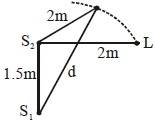
Two coherent sources of sound, $S_{1}$ and $S_{2}$ produce sound waves of the same wavelength, $\lambda=1\, m ,$ in phase. $S_{1}$ and $S_{2}$ are placed $1.5\, m$ apart (see fig.) A listener, located at $L,$ directly in front of $S_{2}$ finds that the intensity is at a minimum when he is $2\,m$ away from $S _{2}$. The listener moves away from $S _{1},$ keeping his distance from $S_{2}$ fixed. The adjacent maximum of intensity is observed when the listener is at a distance $d$ from $S$$_{1}$. Then, $d$ is$......m$
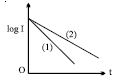
A capacitor of capacity $C$ is charged to a steady potential difference $V$ and connected in series with an open key and a pure resistor $'R'$. At time $t = 0$, the key is closed. If $I =$ current at time $t$, a plot of log $I$ against $'t'$ is as shown in $(1)$ in the graph. Later one of the parameters i.e. $V, R$ or $C$ is changed keeping the other two constant, and the graph $(2)$ is recorded. Then
Assertion : Electric potential and electric potential energy are different quantities.

Reason : For a system of positive test charge and point charge electric potential energy $=$ electric potential.

A new temperature scale uses $X$ as a unit of temperature, where the numerical value of the temperature $t_x$ in this scale is related to the absolute temperature $T$ by $t_x=3 T+100$. If the specific heat of a material using this unit is $1400 \,J kg ^{-1} K ^{-1}$, its specific heat in the SI system of units is
A particle of mass $m$ is projected from the ground with an initial speed $u_0$ at an angle $\alpha$ with the horizontal. At the highest point of its trajectory, it makes a completely inelastic collision with another identical particle, which was thrown vertically upward from the ground with the same initial speed $u_0$. The angle that the composite system makes with the horizontal immediately after the collision is :
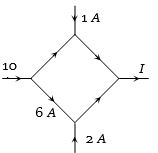
The figure shows a network of currents. The magnitude of currents is shown here. The current $I$ will be ........... $A$
A $0.10\, kg$ block oscillates back and forth along a horizontal surface. Its displacement from the origin is given by: $x = (10\,cm)\cos [(10\,rad/s)\,t + \pi /2\,rad]$. What is the maximum acceleration experienced by the block
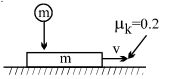
$A$ ball of mass $m$ falls vertically from a height $h$ and collides with $a$ block of equal mass $m$ moving horizontally with $a$ velocity $v$ on $a$ surface. The coefficient of kinetic friction between the block and the surface is $0.2$, while the coefficient of restitution $e$ between the ball and the block is $0.5.$ There is no friction acting between the ball and the block. The velocity of the block decreases by
$105$ calories of heat is required to raise the temperature of $3$ moles of an ideal gas at constant pressure from $30^{\circ} C$ to $35^{\circ} C$. The amount of heat required in calories to raise the temperature of the gas through the range $\left(60^{\circ} C\right.$ to $\left.65^{\circ} C \right)$ at constant volume is ........ $cal$ $\left(\gamma=\frac{C_p}{C_v}=1.4\right)$
Curie's law states that