A semiconductor is cooled from
to
Its resistance
|
(a) Will decrease |
|
(b) Will increase |
|
(c) Will first decrease and then increase |
|
(d) Will not change |
A semiconductor is cooled from
to
Its resistance
|
(a) Will decrease |
|
(b) Will increase |
|
(c) Will first decrease and then increase |
|
(d) Will not change |
(b) Will increase
Generate a complete, print-ready paper with questions like this in minutes — across 16+ boards, with answer keys.

Assertion : An electron is not deflected on passing through certain region of space. This observation confirms that there is no magnetic field in that region.
Reason : The deflection of electron depends on angle between velocity of electron and direction of magnetic field.
|
(a) If both assertion and reason are true and the reason is the correct explanation of the assertion. |
|
(b) If both assertion and reason are true but reason is not the correct explanation of the assertion. |
|
(c) If assertion is true but reason is false. |
|
(d) If assertion is false but reason is true. |
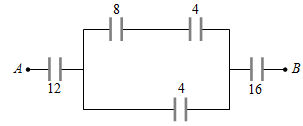
What is the equivalent capacitance between A and B in the given figure (all are in farad)

|
(a) |
(b) |
(c) |
(d) |
If the radioactive decay constant of radium is 1.07
per year, then its half life period is approximately equal to
|
(a) 8,900 years |
(b) 7,000 years |
(c) 6,476 years |
(d) 2,520 years |
GaAs is
|
(a) Element semiconductor |
(b) Alloy semiconductor |
|
(c) Bad conductor |
(d) Metallic semiconductor |
A heater draws a current of 2A when connected to a 250V source. The rate of energy dissipation is
|
(a) 500 W |
(b) 1000 W |
(c) 250 W |
(d) 125 W |
Electromagnetic radiation of highest frequency is
|
(a) Infrared radiations |
(b) Visible radiation |
(c) Radio waves |
(d) g-rays |
Assertion : Silicon is preferred over germanium for making semiconductor devices.
Reason : The energy gap for germanium is more than the energy gap of silicon.
|
(a) If both assertion and reason are true and the reason is the correct explanation of the assertion. |
|
(b) If both assertion and reason are true but reason is not the correct explanation of the assertion. |
|
(c) If assertion is true but reason is false. |
|
(d) If the assertion and reason both are false. |