A semiconductor $X$ is made by doping a germanium crystal with arsenic $(Z=33)$. A second semiconductor $Y$ is made by doping germanium with indium $(Z=49)$. The two are joined end to end and connected to a battery as shown. Which of the following statements is correct
[Orissa JEE 1998]


Download our appand get started for free
Experience the future of education. Simply download our apps or reach out to us for more information. Let's shape the future of learning together!No signup needed.*
Similar Questions
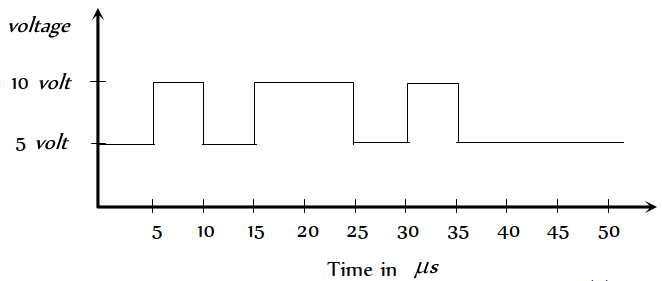
- 1View SolutionIn a negative logic the following wave form corresponds to the
- 2In a transistor configuration $\beta$-parameter isView Solution
- 3View SolutionWhen phosphorus and antimony are mixed in zermaniun, then
- 4View SolutionZener breakdown in a semi-conductor diode occurs when
- 5View SolutionLeast doped region in a transistor
- 6View SolutionTo a germanium sample, traces of gallium are added as an impurity. The resultant sample would behave like
- 7If $n$ and $v$ be the number of electrons and drift velocity in a semiconductor. When the temperature is increasedView Solution
- 8The plate resistance of a triode is $2.5 \times 10^4 \Omega$ and mutual conductance is $2 \times 10^{-3} mho$. What will be the value of amplification factorView Solution
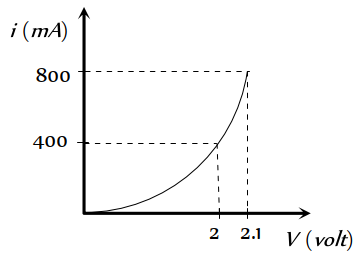
- 9The $i-V$ characteristic of a $P-N$ junction diode is shown below. The approximate dynamic resistance of the $P-N$ junction when a forward bias of $2$ volt is appliedView Solution
- 10View SolutionIn a triode valve