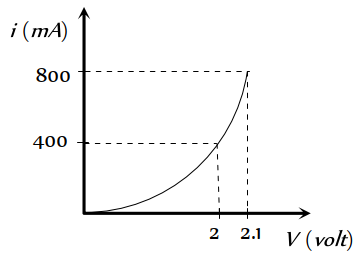
The $i-V$ characteristic of a $P-N$ junction diode is shown below. The approximate dynamic resistance of the $P-N$ junction when a forward bias of $2$ volt is applied


Download our appand get started for free
Experience the future of education. Simply download our apps or reach out to us for more information. Let's shape the future of learning together!No signup needed.*
Similar Questions
- 1View SolutionWhich of the following semi-conductor diodes is reverse biased
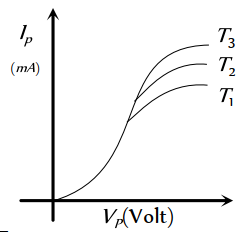
- 2View SolutionFor the diode, the characteristic curves are given at different temperature. The relation between the temperatures is
- 3The grid voltage of any triode valve is changed from $-1$ volt to $-3$ volt and the mutual conductance is $3 \times 10^{-4} mho$. The change in plate circuit current will beView Solution
- 4When the $P$ end of $P-N$ junction is connected to the negative terminal of the battery and the $N$ end to the positive terminal of the battery, then the $P-N$ junction behaves likeView Solution
- 5In a forward biased $P N$-ju nction diode, the potential barrier in the depletion region is of the form ...View Solution
- 6In a semiconducting material the mobilities of electrons and holes are $\mu$ and $\mu$ respectively. Which of the following is trueView Solution
- 7View SolutionWhen a semiconductor is heated, its resistance
- 8View SolutionIn comparison to a half wave rectifier, the full wave rectifier gives lower
- 9View SolutionThe mutual characteristic of triode is
- 10In a triode valve the amplification factor is $20$ and mutual conductance is $10$ mho. The plate resistance isView Solution