The plates of a parallel plate capacitor of capacity $50\,\mu C$ are charged to a potential of $100\;volts$ and then separated from each other so that the distance between them is doubled. How much is the energy spent in doing so
Medium
Download our app for free and get started
(a) ${W_{ext}} = \frac{1}{2}C'V{'^2} - \frac{1}{2}C{V^2}$
$ = \left( {\frac{1}{2}} \right)\,\left( {\frac{C}{2}} \right)\,{(2V)^2} - \frac{1}{2}C{V^2} = \frac{1}{2}C{V^2}$
${W_{ext}} = \frac{1}{2} \times 50 \times {10^{ - 6}} \times {(100)^2} = 25 \times {10^{ - 2}}\,J$
$ = \left( {\frac{1}{2}} \right)\,\left( {\frac{C}{2}} \right)\,{(2V)^2} - \frac{1}{2}C{V^2} = \frac{1}{2}C{V^2}$
${W_{ext}} = \frac{1}{2} \times 50 \times {10^{ - 6}} \times {(100)^2} = 25 \times {10^{ - 2}}\,J$

Download our appand get started for free
Experience the future of education. Simply download our apps or reach out to us for more information. Let's shape the future of learning together!No signup needed.*
Similar Questions
- 1If $n$ drops, each of capacitance $C$, coalesce to form a single big drop, then the ratio of the energy stored in the big drop to that in each small drop will beView Solution
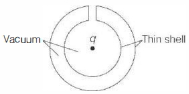
- 2A positive charge $q$ is placed at the centre of a neutral hollow cylindrical conducting shell with its cross-section as shown in the figure below. Which one of the following figures correctly indicates the induced charge distribution on the conductor? (Ignore edge effects)View Solution
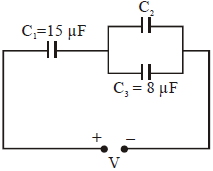
- 3In the circuit shown in the figure, the total charge in $750\, \mu C$ and the voltage across capacitor $C _{2}$ is $20\, V$. Then the charge on capacitor $C _{2}$ is$....\mu C$View Solution
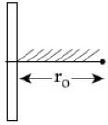
- 4A positive point charge is released from rest at a distance $r_0$ from a positive line charge with uniform density. The speed $(v)$ of the point charge, as a function of instantaneous distance $r$ from line charge, is proportional toView Solution
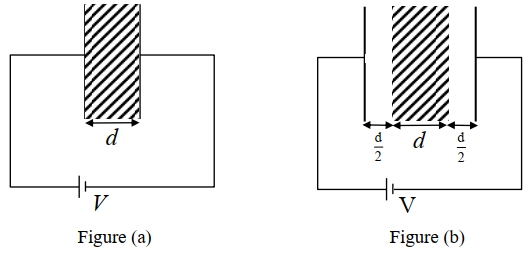
- 5A medium having dielectric constant $K>1$ fills the space between the plates of a parallel plate capacitor. The plates have large area, and the distance between them is $d$. The capacitor is connected to a battery of voltage $V$. as shown in Figure ($a$). Now, both the plates are moved by a distance of $\frac{d}{2}$ from their original positions, as shown in Figure ($b$).View Solution
In the process of going from the configuration depicted in Figure ($a$) to that in Figure ($b$), which of the following statement($s$) is(are) correct?
- 6View SolutionIn the circuit shown in figure
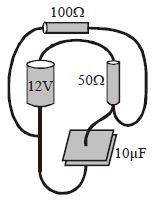
- 7Two capacitors with capacitance values $C _1=2000 \pm 10 pF$ and $C_2=3000 \pm 15 pF$ are connected in series. The voltage applied across this combination is $V=5.00 \pm 0.02 V$. The percentage error in the calculation of the energy stored in this combination of capacitors is . . . . . .View Solution
- 8A parallel plate capacitor filled with a medium of dielectric constant $10$ , is connected across a battery and is charged. The dielectric slab is replaced by another slab of dielectric constant $15$ . Then the energy of capacitor will ......................View Solution
- 9A spherical drop of capacitance $1\,\,\mu F$ is broken into eight drops of equal radius. Then, the capacitance of each small drop is ......$\mu F$View Solution
- 10A capacitor of capacitance $1$ $\mu F$ withstands the maximum voltage $6$ $kV$ while a capacitor of $2$ $\mu F$ withstands the maximum voltage $4$ $kV$. What maximum voltage will the system of these two capacitor withstands if they are connected in series?......$kV$View Solution