MCQ
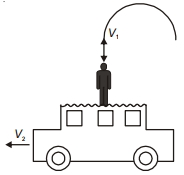
A shell is fired vertically upwards with a velocity $v_1$ from a trolley moving horizontally with velocity $v_2$. A person on the ground observes the motion of the shell as a parabola, whose horizontal range is ....
  • A
    $\frac{2 v_1^2 v_2}{g}$
  • B
    $\frac{2 v_1^2}{g}$
  • C
    $\frac{2 v_2^2}{g}$
  • $\frac{2 v_1 v_2}{g}$

Answer

Correct option: D.
$\frac{2 v_1 v_2}{g}$
d
(d)

There is no acceleration in the horizontal direction.

$S_x=U_x T+\frac{1}{2} a_0 \times T^2$

$R=U_x T \ldots (1)$

$S_y=U_y T+\frac{1}{2} g_y T^2$

$O=V_1 T-\frac{1}{2} g T^2$

$\Rightarrow V_1 T=\frac{1}{2} g T$

$T=\frac{2 V_1}{g}$

We know,

$(R)$ range $=($ Horizontal velocity $4 x) \times$ flight $+$ time $(T)$

i.e., $R=4 x \times T$

$R=V_2 \times \frac{2 V_1}{g} \Rightarrow \frac{2 V_1 V_2}{g}$

Need a full question paper?

Generate a complete, print-ready paper with questions like this in minutes — across 16+ boards, with answer keys.

Start Generating Free

Similar questions

If the radius of curvature of the path of two particles of same mass are in the ratio $3:4,$ then in order to have constant centripetal force, their velocities will be in the ratio of:
If the radius of the earth were to shrink by $1\%$ its mass remaining the same, the acceleration due to gravity on the earth's surface would
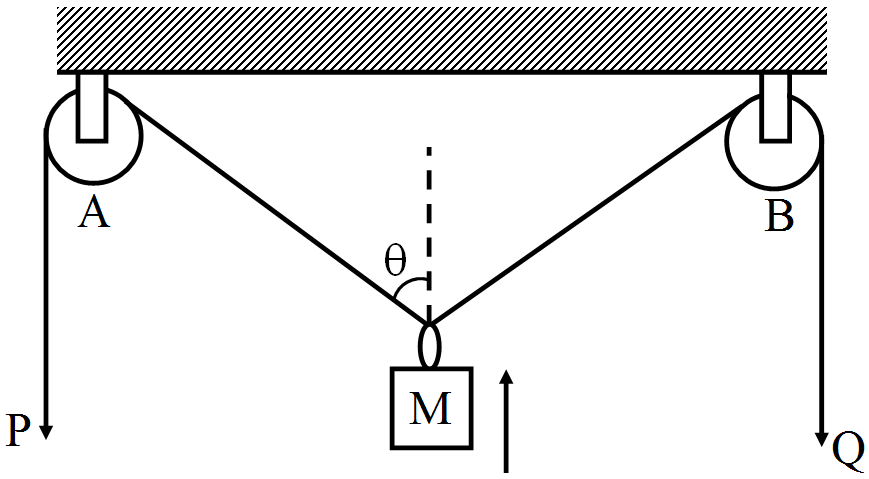
In the arrangement shown in figure, the ends P and Q of an inextensible string move downwards with uniform speed u. Pulleys A and B are fixed. The mass M moves upwards with a speed:
A tube closed at one end and containing air is excited. It produces the fundamental note of frequency $512 Hz$. If the same tube is open at both the ends the fundamental frequency that can be produced is .... $Hz$
Moment of inertia of a square plate of side $l$ about the axis passing through one of the corner and perpendicular to the plane of square plate is given by
Which of the following has largest moment of inertia?
The length of a wire is $1.0\, m$ and the area of cross-section is $1.0 \times {10^{ - 2}}\,c{m^2}$. If the work done for increase in length by $0.2\, cm$ is $0.4\, joule$, then Young's modulus of the material of the wire is
Join the relation of physical quantities in Column$-I$ to the details given in Column$-II$ appropriately :
Column $-I$  Column $-II$ 
$(a)$ Stress $\propto $ Strain $(i)$ $M^1\,L^{-1}\,T^{-2}$
$(b)$ Dimensional formula for compressibility  $(ii)$ $M^{-1}\,L^{1}\,T^{-2}$
  $(iii)$ Poisson’s ratio
  $(iv)$ Hooke’s law
Write the dimensions of $a/b$ in the relation $P = \frac{{a - {t^2}}}{{bx}}$ , where $P$ is pressure, $x$ is the distance and $t$ is the time 
The graphs in figure show that a quantity $y$ varies with displacement $d$ in a system undergoing simple harmonic motion. Which graphs best represents the relationship obtained when $y$ is The time