MCQ
The graphs in figure show that a quantity $y$ varies with displacement $d$ in a system undergoing simple harmonic motion. Which graphs best represents the relationship obtained when $y$ is The time

  • A
    $I$
  • B
    $II$
  • C
    $III$
  • $IV$

Answer

Correct option: D.
$IV$
d
Distance versus time curve is like the rotated curve $IV$ for an $SHM$ since distance follows a $wave-lke$ path about the mean position. Thus $time-displacement$ curve will be it's rotated version, or curve $IV$

Need a full question paper?

Generate a complete, print-ready paper with questions like this in minutes — across 16+ boards, with answer keys.

Start Generating Free

Similar questions

The damping force on an oscillator is directly proportional to the velocity.The units of the constant of proportionality are
A tuning fork of frequency $340Hz$ is vibrated just above the tube of $120 cm$ height. Water is poured slowly in the tube. What is the minimum height of water necessary for the resonance .... $cm$ (speed of sound in the air $= 340 m/sec$)
Projectiles $A$ and $B$ are thrown at angles of $45^{\circ}$ and $60^{\circ}$ with vertical respectively from top of a $400 \mathrm{~m}$ high tower. If their ranges and times of flight are same, the ratio of their speeds of projection $v_A: v_B$ is :
A sample of metal weighs $210 gm$  in air, $180 gm$  in water and $120 gm$  in liquid. Then relative density $(RD) $ of
The dimensional formula for electric flux is $..........$
In our solar system, the interplanetary region has chunks of matter $($much smaller in size compared to planets$)$ called asteroids. They
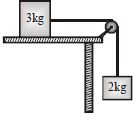
Consider a body of mass $3\,kg$ at rest on a smooth horizontal table. This body is  connected by a light string, which passes over a smooth pulley at the edge of the  table, to another body of mass $2\, kg$ hanging freely. This $2\, kg$ mass is released  from rest. Now consider the following statements :-

$(A)$ The masses remains at rest

$(B)$ The $3\,kg$ mass moves uniformly while $2\, kg$ mass moves with acceleration $\frac{2}{5}\, g \,m/s^2$

$(C)$ Both bodies move with acceleration $\frac{2}{5} \,g \,m/s^2$

$(D)$ The tension in the string near the first body is more than that near the second  body 

$(E)$ The tension in the string is $\frac{6g}{5}\, N $

Then the correct statements are
A wheel having moment of inertia $2\,kg-m^2$ about its vertical axis, rotates at the rate of $60\,rpm$ about the axis. The torque which can stop the wheel’s rotation in one minute would be
A body of mass $m$ is taken to the bottom of a deep mine. Then
In an experiment, the percentage of error occurred in the measurment of physical quantities $A, B, C$ and $D$ are $1 \%, 2 \%, 3 \%$ and $4 \%$ respectively. Then the maximum percentage of error in the measurement $X,$

where $X = \frac{{{A^2}{B^{\frac{1}{2}}}}}{{{C^{\frac{1}{3}}}{D^3}}}$, will be