Question
A transformer is essentially an $a.c.$ device. It cannot work on $d.c.$ It changes altemating voltages or currents. It does not affect the frequency of $a.c.$ It is based on the phenomenon of mutual induction. A transformer essentially consists of two coils of insulated copper wire having different number of tums and wound on the same soft iron core.
The number of turns in the primary and secondary coils of an ideal transfonner are $2000$ and $50$ respectively. The primary coil is connected to a main supply of $120V$ and secondary coil is connected to a bulb of resistance $0.6\Omega.$
  1. The value of voltage across the secondary coil is:
  1. $5V$
  2. $2V$
  3. $3V$
  4. $10V$
  1. The value of current in the bulb is:
  1. $7A$
  2. $15A$
  3. $3A$
  4. $5A$
  1. The value of current in primary coil is:
  1. $0.125A$
  2. $2.52A$
  3. $1.51A$
  4. $3.52A$
  1. Power in primary coil is:
  1. $20W$
  2. $5W$
  3. $10W$
  4. $15W$
  1. Power in secondary coil is:
  1. $15W$
  2. $20W$
  3. $7W$
  4. $8W$

Answer

  1. $(c) \ 3V$
As, $\frac{\text{E}_\text{s}}{\text{E}_\text{p}}=\frac{\text{n}_\text{s}}{\text{n}_\text{p}}$
$\Rightarrow\text{E}_\text{s}=\text{E}_\text{p}\times\frac{\text{n}_\text{p}}{\text{n}_\text{p}}$
$=\frac{120\times50}{2000}$
$=3\text{V}$
  1. $(d) \ 5A$
$\text{I}_0=\frac{\text{E}_\text{S}}{\text{R}}$
$\Rightarrow\text{I}_0=\frac{3}{0.6}=5\text{A}$
  1. $(a) \ 0.125A$
As, $\frac{\text{I}_\text{P}}{\text{I}_\text{S}}=\frac{\text{E}_\text{S}}{\text{E}_\text{P}}$
$\Rightarrow\text{I}_\text{p}=\frac{\text{E}_\text{S}}{\text{E}_\text{P}}\times\text{I}_\text{S}$
$=\frac{3}{120}\times5$
$=0.125\text{A}$
  1. $(d) \ 15W$
Power in primary, $P_{P }$
$= E_P \times I_{P }$
$= 120 \times 0.125$
$= 15W$
  1. $(a) \ 15W$
Power in secondary coil, $P_S = E_S \times I_S $
​​​​​​​$= 3 \times 5$
$= 15W$

Need a full question paper?

Generate a complete, print-ready paper with questions like this in minutes — across 16+ boards, with answer keys.

Start Generating Free

Similar questions

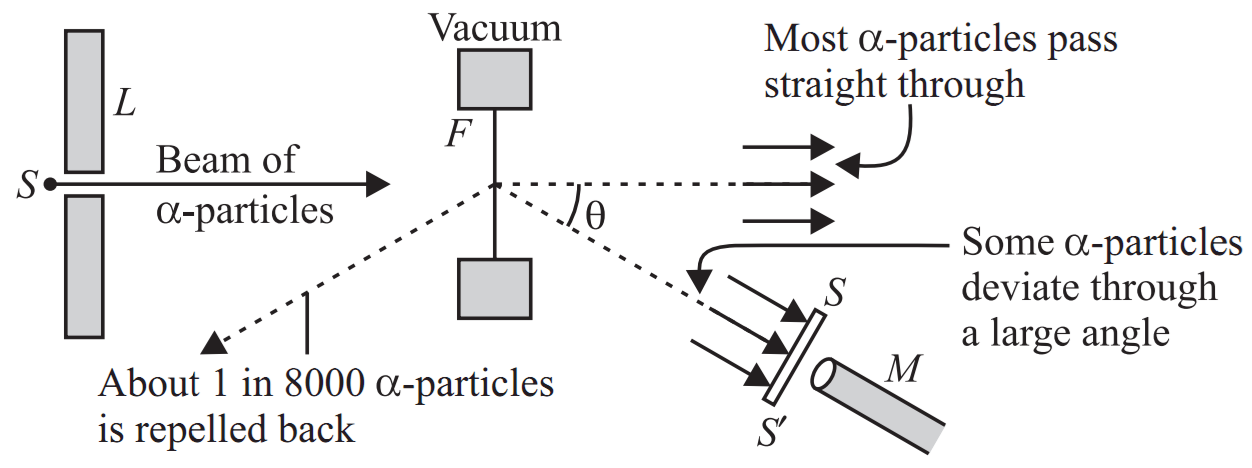
In $1911,$ Rutherford, along with his assistants, $H$.
Geiger and $E$. Marsden, performed the alpha particle scattering experiment. $H$.
Geiger and $E$. Marsden took radioactive source $(^{214}_{83}\text{Bi})$ for $\alpha- $ particles.
A collimated beam of $\alpha-$ particles of energy $5.5 MeV$ was allowed to fall on $2.1 \times 10^{-7} m$ thick gold foil. The $\alpha-$ particles were observed through a rotatable detector consisting of a Zinc sulphide screen and microscope. It was found that $CL-$ particles got scattered. These scattered $\alpha-$ particles produced scintillations on the zinc sulphide screen. Observations of this experiment are as follows?
Most of the $\alpha-$ particles passed through the foil without deflection.
Only about $0.14\%$ of the incident $\alpha-$ particles scattered by more than $1^\circ$
Only about one $\alpha-$ particle in every $8000 \ \alpha-$ particles deflected by more than $90^\circ$
These observations led to many arguments and conclusions which laid down the structure of the nuclear model of an atom.
  1. Rutherford's atomic model can be visualised as.
  1. Gold foil used in Geiger $-$ Marsden experiment is about $10^{-8}m$ thick. This ensures.
  1. Gold foil's gravitational pull is small or possible.
  2. Gold foil is deflected when $\alpha-$ particle stream is not incident centrally over it.
  3. Gold foil provides no resistance to passage of $\alpha-$ particles.
  4. Most $\alpha-$ particle will not suffer more than $1^\circ$ scattering during passage through gold foil.
  1. In Geiger $-$ Marsden scattering experiment, the trajectory traced by an $\alpha-$ particle depends on.
  1. Number of collision.
  2. Number of scattered $\alpha- $ particles.
  3. Impact parameter.
  4. None of these.
  1. In the Geiger $-$ Marsden scattering experiment, in case of head $-$ on collision, the impact parameter should be.
  1. Maximum
  2. Minimum
  3. Infinite
  4. zero
  1. The fact only a small fraction of the number of incident particles rebound back in Rutherford scattering indicates that.
  1. Number of $\alpha-$ particles undergoing head $-$ on $-$ collision is small.
  2. Mass of the atom is concentrated in a small volume.
  3. Mass of the atom is concentrated in a large volume.
  4. Both $(a)$ and $(b).$
To convert two atoms into ions, 2 electrons have been removed from each of them. When these ions are placed in a vacuum, they repel each other with a force of $3.7 \times 10^{-9}$ Newton. Find the distance between them.
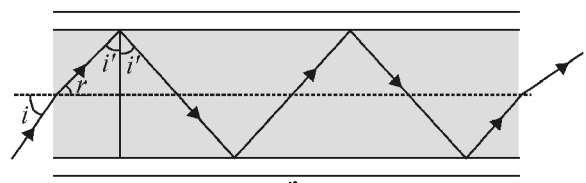
(a) Figure shows a cross-section of a 'light pipe' made of a glass fibre of refractive index 1.68. The outer covering of the pipe is made of a material of refractive index 1.44. What is the range of the angle of the incident rays with the axis of the pipe for which total reflections inside the pipe take place, as shown in the figure. Image
(b) What is the answer if there is no outer covering of the pipe?
Plot a graph showing variation of de-Broglie wavelength $ \lambda $ versus $ 1/\sqrt{V} $ where V is accelerating potential for two particles A and B carrying same charge but of masses $ m_{1} $ and $ m_{2} $, where $ m_{1}>m_{2} $
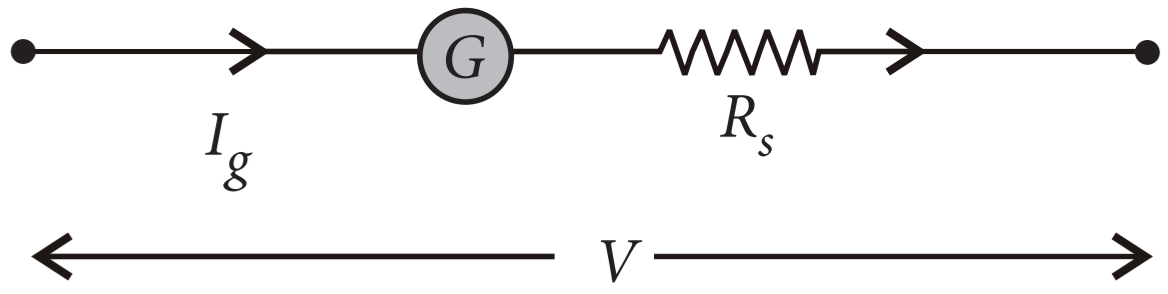
A galvanometer can be converted into voltmeter of given range by connecting a suitable resistance $R,$ in series with the galvanometer, whose value is given by, $\text{R}_\text{s}=\frac{\text{V}}{\text{I}_\text{g}}-\text{G}$
where vis the voltage to be measured, $lg$ is the current for full scale deflection of galvanometer and $G$ is the resistance of galvanometer.

Series resistor$(R,)$ increases range of voltmeter and the effective resistance of galvanometer. It also protects the galvanometer from damage due to large current. Voltmeter is a high resistance instrument and it is always connected in parallel with the circuit element across which potential difference is to be measured. An ideal voltmeter has infinite resistance. In order to increase the range of voltmeter $n$ times the value of resistance to be connected in series with galvanometer is $R_s = (n - 1)G.$
  1. $10\ mA$ current can pass through a galvanometer of resistance $25\Omega$ What resistance in series should be connected through it, so that it is converted into a voltmeter of $100V$?
  1. $0.975\Omega$
  2. $99.75\Omega$
  3. $975\Omega$
  4. $9975\Omega$
  1. There are $3$ voltmeter $A, B, C$ having the same range but their resistance are $15000\Omega,10000\Omega,$ and $5000\Omega$ respectively. 'Tile best voltmeter amongst them is the one whose resistance is
  1. $5000\Omega$
  2. $10000\Omega$
  3. $15000\Omega$
  4. all are equally good.
  1. A milliammeter of range 0 to $25\ mA$ and resistance of $10\Omega$ is to be converted into a voltmeter with a range of 0 to $25V.$ 'Tile resistance that should be connected in series will be:
  1. $930\Omega$
  2. $960\Omega$
  3. $990\Omega$
  4. $1010\Omega$
  1. To convert a moving coil galvanometer $\ce{(MCG)}$ into a voltmeter:
  1. $A$ high resistance $R$ is connected in parallel with $\ce{MCG}.$
  2. $A$ low resistance $R$ is connected in parallel with $\ce{MCG}.$
  3. $A$ low resistance $R$ is connected in series with $\ce{MCG}.$
  4. $A $ high resistance $R$ is connected in series with $\ce{MCG}.$
  1. To increase the current sensitivity of a moving coil galvanometer, we should decrease:
  1. Zero.
  2. Low.
  3. High.
  4. Infinity.
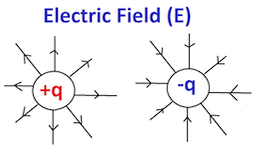
Electric field intensity at any point is the strength of the electric field at that point. It is also defined as the force experienced by unit positive charge placed at that point. Electric Field Intensity is a vector quantity. It is denoted by E. When placed within the electric field, the test charge will experience an electric force - either attractive or repulsive.
Image
(i) The Electric field at a point is
(a) discontinuous only if there is a negative charge at that point
(b) always continuous
(c) continuous if there is charge at that point
(d) continuous if there is no charge at that point

(ii) A charge is distributed uniformly over a ring of radius a. Obtain an expression for the electric intensity E at a point on the axis of the ring. Hence the points at large distances from the ring, it behaves like a point charge is:
(a) $E =\frac{1}{4 \pi \varepsilon_0} \cdot \frac{q}{x}$
(b) $E =\frac{1}{2 \pi \varepsilon_0} \cdot \frac{Q}{x^2}$
(c) $E =\frac{1}{4 \pi \varepsilon_0} \cdot \frac{q}{x^4}$
(d) $E =\frac{1}{4 \pi \varepsilon_0} \cdot \frac{Q}{x^2}$

(iii) Force acting on an electron in a uniform electric field of $5 \times 10^4 N / C$ is:
(a) $8 \times 10^{-15} N$
(b) $-7 \times 10^{-15} N$
(c) $-8 \times 10^{-15} N$
(d) $7 \times 10^{-15} N$

(iv) At a particular point, the electric field depends upon:
(a) source charge Q only
(b) both Q and q
(c) test charge $q_0$ only
(d) neither Q nor q

OR

Four charges of the same magnitude and same sign are placed at the corners of a square, of each side 0.1 m. then electric field intensity at the centre of the square is:
(a) $0.01 N / C$
(b) $0.25 N / C$
(c) zero
(d) $0.1 N / C$

A long bar magnet has a pole strength of 10A-m. Find the magnetic field at a point on the axis of the magnet at a distance of 5cm from the north pole of the magnet.
Derive the formula of electric potential at a point due to electric dipole.
An amount $n ($in moles$)$ of a monatomic gas at an initial temperature $T_0$ is enclosed in a cylindrical vessel fitted with a light piston. The surrounding air has a temperature $T_s(> T_0)$ and the atmospheric pressure is $P_a·$ Heat may be conducted between the surrounding and the gas through the bottom of the cylinder. The bottom has a surface area $A,$ thickness $x$ and thermal conductivity$ K.$ Assuming all changes to be slow, find the distance moved by the piston in time $t.$
In a chamber, a uniform magnetic field of 6.5 G (1 G = 10-4T ) is maintained. An electron is shot into the field with a speed of 4.8 X 10⁶ m s-1normal to the field. Explain why the path of the electron is a circle. Determine the radius of the circular orbit.
$\left( e =1.6 \times 10^{-19} C , m_e=9.1 \times 10^{-31} kg\right)$