Question
A short magnet makes 40 oscillations per minute when used in an oscillation magnetometer at a place where the earth's horizontal magnetic field is $2\mu\text{T.}$ Another short magnet of magnetic moment 1.6A-m2 is placed 20cm east of the oscillating magnet. Find the new frequency of oscillation if the magnet has its north pole:
  1. Towards north.
  2. Towards south.

Answer

$\gamma_1=40$ oscillations/ minute

$\text{B}_\text{H}=25\mu\text{T}$

m of second magnet = 1.6A-m2

d = 20cm = 0.2m

For north facing north

$\gamma_1=\frac{1}{2\pi}\sqrt{\frac{\text{MB}_{\text{H}}}{\text{I}}}$

$\gamma_2=\frac{1}{2\pi}\sqrt{\frac{\text{M}(\text{B}_{\text{H}}-\text{B})}{\text{I}}}$

$\text{B}=\frac{\mu_0}{4\pi}\frac{\text{m}}{\text{d}^3}=\frac{10^{-7}\times1.6}{8\times10^{-3}}=20\mu\text{T}$

$\frac{\gamma_1}{\gamma_2}=\sqrt{\frac{\text{B}}{\text{B}_{\text{H}-\text{B}}}}\Rightarrow\frac{40}{\gamma_2}=\sqrt{\frac{25}{5}}\Rightarrow\gamma_2=\frac{40}{\sqrt{5}}$

$=17.88\approx18\text{ osci/min}$ 

For north pole facing south

$\gamma_1=\frac{1}{2\pi}\sqrt{\frac{\text{MB}_{\text{H}}}{\text{I}}}$

$\gamma_2=\frac{1}{2\pi}\sqrt{\frac{\text{M}(\text{B}_{\text{H}}-\text{B})}{\text{I}}}$

$\frac{\gamma_1}{\gamma_2}=\sqrt{\frac{\text{B}}{\text{B}_{\text{H}-\text{B}}}}\Rightarrow\frac{40}{\gamma_2}=\sqrt{\frac{25}{45}}\Rightarrow\gamma_2=\frac{40}{\sqrt{\Big(\frac{25}{45}\Big)}}$

$=53.66\approx54\text{ osci/min}$

Need a full question paper?

Generate a complete, print-ready paper with questions like this in minutes — across 16+ boards, with answer keys.

Start Generating Free

Similar questions

A plumb bob is hung from the ceiling of a train compartment. If the train moves with an acceleration 'a' along a straight horizontal track, the string supporting the bob makes an angle $\tan^{-1}\Big(\frac{\text{a}}{\text{g}}\Big)$ with the normal to the ceiling. Suppose the train moves on an inclined straight track with uniform velocity. If the angle of incline is $\tan^{-1}\Big(\frac{\text{a}}{\text{g}}\Big),$ the string again makes the same angle with the normal to the ceiling. Can a person sitting inside the compartment tell by looking at the plumb line whether the train is accelerated on a horizontal straight track or it is going on an incline? If yes, how? If no, suggest a method to do so.
Read the passage given below and answer the following questions from (i) to (v).
All engineering phenomena deal with definite and measured quantities and so depend on the making of the measurement. We must be
clear and precise in making these measurements. To make a measurement, magnitude of the physical quantity (unknown) is compared.
The record of a measurement consists of three parts, i.e. the dimension of the quantity, the unit which represents a standard quantity and a number which is the ratio of the measured quantity to the standard quantity.
  1. A device which is used for measurement of length to an accuracy of about 10-5m, is:
  1. Screw gauge
  2. Spherometer
  3. Vernier callipers
  4. Either (a) or (b)
  1. Which of the technique is not used for measuring time intervals?
  1. Electrical oscillator
  2. Atomic clock
  3. Spring oscillator
  4. Decay of elementary particles
  1. The mean length of an object is 5cm. Which of the following measurements is most accurate?
  1. 4.9cm
  2. 4.805cm
  3. 5.25cm
  4. 5.4cm
  1. If the length of rectangle l = 10.5cm, breadth b = 2.1cm and minimum possible measurement by scale = 0.1cm, then the area is:
  1. 22.0cm2
  2. 21.0cm2
  3. 22.5cm2
  4. 21.5cm2
  1. Age of the universe is about 1010 yr, whereas the mankind has existed for 10yr. For how many seconds would the man have existed, if age of universe were 1 day?
  1. 9.2s
  2. 10.2s
  3. 8.6s
  4. 10.5s
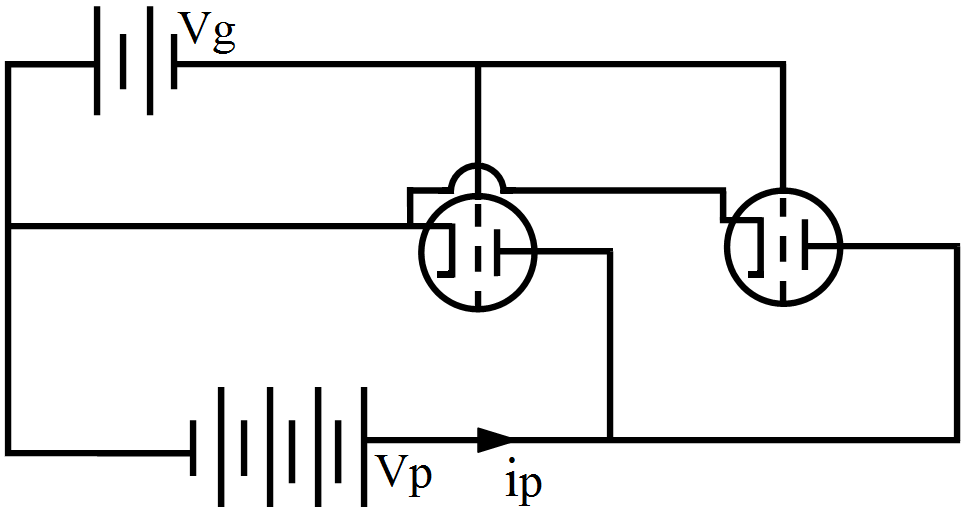
The figure shows two identical triode tubes connected in parallel. The anodes are connected together and the cathodes are connected together. Show that the equivalent plate resistance is half the individual plate resistance, the equivalent mutual conductance is double the

individual mutual conductance and the equivalent amplification factor is the same as the individual amplification factor.
In a microwave oven, the food is kept in a plastic container and the microwave is directed towards the food. The food is cooked without melting or igniting the plastic container. Explain.
Calculate the force with which you attract the earth.
Two long bar magnets are placed with their axes coinciding in such a way that the north pole of the first magnet is 2·0cm from the south pole of the second. If both the magnets have a pole strength of 10A-m, find the force exerted by one magnet on the other.
The plate current in a triode can be written as $\text{i}_\text{p}=\text{k}\Big(\text{V}_\text{g}+\frac{\text{V}_\text{p}}{\mu}\Big)^{\frac{3}{2}}$ Show that the mutual conductance is proportional to the cube root of the plate current.
A hot body is placed in a closed room maintained at a lower temperature. Is the number of photons in the room increasing?
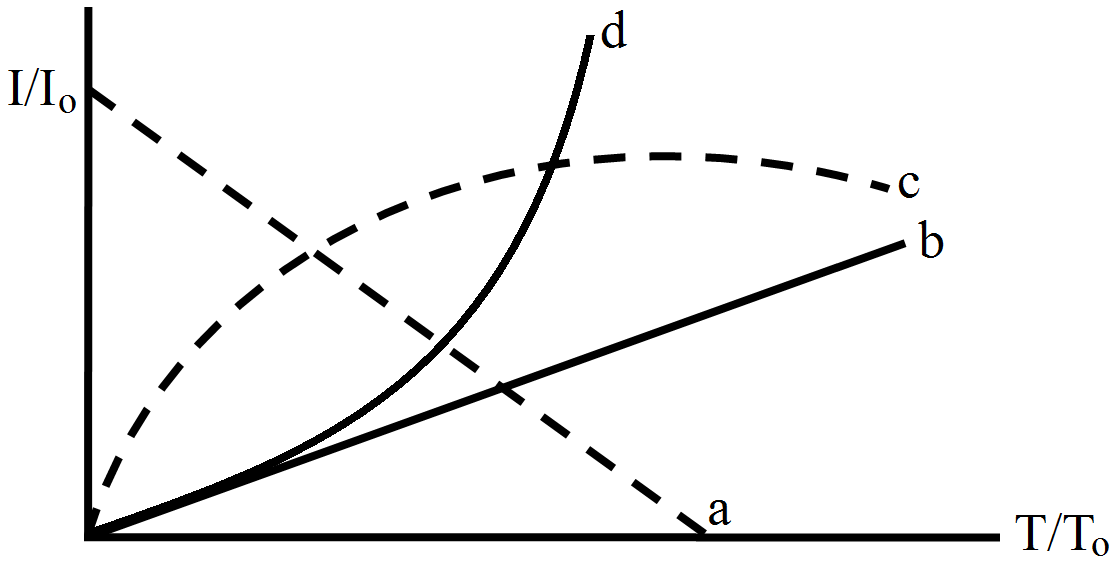
Let i0 be the thermionic current from a metal surface when the absolute temperature of the surface is T0. The temperature is slowly increased and the thermionic current is measured as a function of temperature. Which of the following plots may represent the variation in $\Big(\frac{\text{i}}{\text{i}_0}\Big)$ against $\Big(\frac{\text{T}}{\text{T}_0}\Big)?$

Read the passage given below and answer the following questions from 1 to 5.
Principle of Conservation of Energy:
Total energy of an isolated system always remains constant. Since, the universe as a whole may be viewed as an isolated system, total energy of the universe is constant. If one part of the universe loses energy, then other part must gain an equal amount of energy. The principle of conservation of energy cannot be proved as such. However, no violation of this principle has been observed.
  1. When we rub two flint stones together, got them to heat up and to ignite a heap of dry leaves in the form of:
  1. chemical energy
  2. sound energy
  3. heat energy
  4. electrical energy
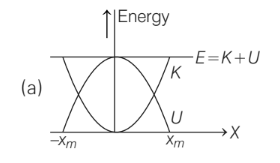
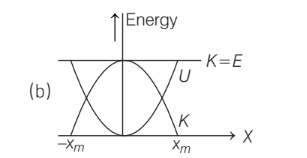
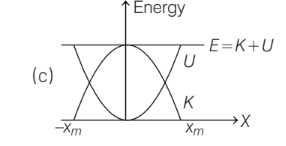
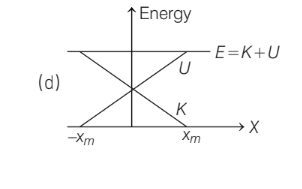
  1. Which graph represents conservation of total mechanical energy?
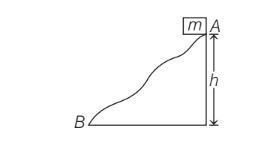
  1. In the given curved road, if particle is released from A, then:

  1. kinetic energy atB must be mgh
  2. kinetic energy atB must be zero
  3. kinetic energy atB must be less than mgh
  4. kinetic energy atB must not be equal to potential energy
  1. U is the potential energy, K is the kinetic energy and E is the mechanical energy. Which of the following is not possible for a stable system?
  1. U > E
  2. U < E
  3. E > K
  4. K > E
  1. A body of mass 5kg is thrown vertically up with a kinetic energy of 490 J. The height at which the kinetic energy of the body becomes half of the original value is
  1. 12.5m
  2. 10
  3. 2.5m
  4. 5m