Question
The figure shows two identical triode tubes connected in parallel. The anodes are connected together and the cathodes are connected together. Show that the equivalent plate resistance is half the individual plate resistance, the equivalent mutual conductance is double the
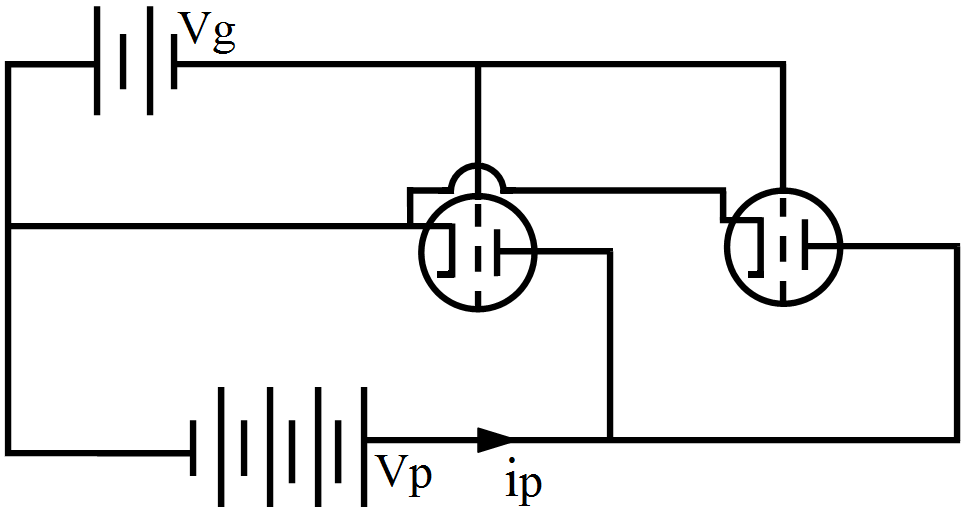
individual mutual conductance and the equivalent amplification factor is the same as the individual amplification factor.
Answer

From the circuit, Cathode of both the triodes are connected to a common point and their anodes are also connected together. Thus, the 2 triodes are connected in parallel.

As plate resistance is obtained by observing the variation of plate voltage with plate current, keeping grid voltage as constant.

Hence equivalent plate resistance,

$\text{R}_\text{p}=\frac{\text{rp}_1\times\text{rp}_2}{\text{rp}_1+\text{rp}_2}$

if both the triodes have equal plate resistance

i.e., $\text{R}_\text{p}=\frac{\text{r}_\text{p}}{2}$

To find the equivalent transconductance.

We need to look at the variation of current with respect to grid voltage, keeping plate voltage as constant.

From the circuit

Now the 2 triodes are in series w.r.t grid voltage.

Hence equivalent transconductance will be equal to

$\text{G}_\text{m}=2\text{g}_\text{m}$

if the 2 triodes have equal trens conductance i.e., $\text{g}_{\text{m}_1}=2\text{g}_{\text{m}_2}=\text{g}_{\text{m}}$

Now the equivalent amplification factor is,

$\mu_{\text{equivalent}}=\text{G}_{\text{m}}\times\text{R}_{\text{p}}$

$\mu_{\text{equivalent}}=2\text{g}_{\text{m}}\times\frac{\text{r}_{\text{p}}}{2}$

$\mu_{\text{equivalent}}=\mu$

Need a full question paper?

Generate a complete, print-ready paper with questions like this in minutes — across 16+ boards, with answer keys.

Start Generating Free

Similar questions

Consider the situation described in the previous problem. Where should a point source be placed on the principal axis so that the two images form at the same place?
Read the passage given below and answer the following questions from (i) to (iv).
Zeroth Law of Thermodynamics states that two systems in thermal equilibrium with a third system separately are in thermal equilibrium with each other. The Zeroth Law clearly suggests that when two systems A and B, are in thermal equilibrium, there must be a physical quantity that has the same value for both. This thermodynamic variable whose value is equal for two systems in thermal equilibrium is called temperature (T). Thus, if A and B are separately in equilibrium with C, TA = TC and TB = TC. This implies that TA = TB i.e. the systems A and B are also in thermal equilibrium. Zeroth Law of Thermodynamics leads to the concept of internal energy of a system. We know that every bulk system consists of a large number of molecules. Internal energy is simply the sum of the kinetic energies and potential energies of these molecules. A certain amount of heat is supplied to the system’ or ‘a certain amount of work was done by the system its energy changes.
  1. Three thermodynamic systems are at temperature of 500 c .what can we say about them?
  1. Heat flows between them
  2. It obeys Zeroth Law of Thermodynamics
  3. Temperature of one system will increase and temperature of remaining two will decrease
  4. None of these
  1. Zeroth law of thermodynamics helped in the creation of which scale?
  1. Temperature
  2. Heat energy
  3. Pressure
  4. Internal energy
  1. State Zeroth Law of Thermodynamics:
  2. Define Internal energy of system:
50cc of oxygen is collected in an inverted gas jar over water. The atmospheric pressure is 99.4kPa and the room temperature is 27°C. The water level in the jar is same as the level outside. The saturation vapour pressure at 27°C is 3.4kPa. Calculate the number of moles of oxygen collected in the jar.
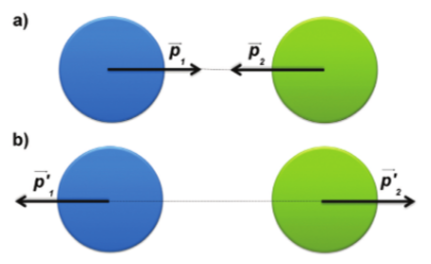
The kinetic energy of an object is the energy associated with the object which is under motion. It is defined as "the energy required by a body to accelerate from rest to stated velocity." It is a vector quantity and the momentum of an object is the virtue of its mass. It is defined as the product of mass and velocity. It is a vector quantity. The relation between them is given by $E =\frac{P^2}{2 m}$. In case of the elastic collision both of these quantities remain constant.
Image
1.Two masses of 1 gm and 4 gm are moving with equal linear momentum. The ratio of their kinetic energy is:
(a) $1: 2$ (b) $4: 1$ (c) $1: 1$ (d) $4: 2$
2. If the linear momentum is increased by $50 \%$, then K .E will be increased by:
(a) $50 \%$ (b) $200 \%$ (c) $125 \%$ (d) $100 \%$
3.A heavy object and a light object have the same momentum. Which has the greater speed?
(a) both heavy and light object
(b) heavy object
(c) Moderate object
(d) light object
OR
Kinetic energy with any reference must be $\qquad$
(a) Change (b) negative (c) zero (d) positive
4.When a body moves with a constant speed along a circle then
(a) no acceleration is produced
(b) no work is done on it
(c) no displacement on it
(d) no force acts on it
Calculate $\frac{\text{n(T)}}{\text{n}(1000\text{K})}$ for tungsten emitter at T = 300K, 2000K and 3000K, where n(T) represents the number of thermions emitted per second by the surface at temperature T. Work function of tungsten is 4.52eV.
(a) A child stands at the centre of a turntable with his two arms outstretched. The turntable is set rotating with an angular speed of 40 rev/min. How much is the angular speed of the child if he folds his hands back and thereby reduces his moment of inertia to 2/5 times the initial value? Assume that the turntable rotates wihout
friction.
(b) Show that the child’s new kinetic energy of rotation is more than the initial kinetic energy of rotation. How do you account for this increase in kinetic energy?
Let us assume that our galaxy consists of $2.5 \times 10^{11}$ stars each of one solar mass. How long will a star at a distance of 50,000 ly from the galactic centre take to complete one revolution? Take the diameter of the Milky way to be $10^5 ly$.
A collision experiment is done on a horizontal table kept in an elevator. Do you expect a change in the results if the elevator is accelerated up or down because of the noninertial character of the frame?