MCQ
A silver sphere of radius $1\ cm$ and work function $4.7 \ eV$ is suspended from an insulating thread in free-space. It is under continuous illumination of $200 \ nm$ wavelength light. As photoelectrons are emitted, the sphere gets charged and acquires a potential. The maximum number of photoelectrons emitted from the sphere is $A \times 10^2$ (where $1 < A < 10$ ). The value of  $'Z '$ is
  • $7$
  • B
    $8$
  • C
    $9$
  • D
    $1$

Answer

Correct option: A.
$7$
a
Let $x$ be the maximum number of photo electrons emitted.

The potential $V$ of the sphere can be calculated as : $U =\frac{ Kq }{ R }$

$V =\frac{9 \times 10^9 \times x \times 1.6 \times 10^{-1} 19}{10^{-2}}= x \times 14.4 \times 10^{-8} $

$ U = eV = x \times 14.4 \times 10^{-8} \times 1.6 \times 10^{-19}= x \times 23.04 \times 10^{-27} J$

From conservation of energy :

$U =\frac{ hC }{\lambda}-\phi $

$x \times 23.04 \times 10^{-27}=\frac{2 \times 10^{-25}}{200 \times 10^{-9}}-4.7 \times 1.6 \times 10^{-19} $

$x =\frac{10^{-18}-7.52 \times 10^{-19}}{23.04 \times 10^{-27}}=1.076 \times 10^7$

$\therefore Z =7$

Need a full question paper?

Generate a complete, print-ready paper with questions like this in minutes — across 16+ boards, with answer keys.

Start Generating Free

Similar questions

A particle excutes $SHM$ on a straight line path. The amplitude of oscillation is $2\,cm$. When the displacement of the particle from the mean position is $1\,cm$, the numerical value of magnitude of acceleration is equal to the numerical value of magnitude of velocity. The frequency of $SHM$ is (in $second^{-1}$)
$A$ wall has two layers $A$ and $B$ made of different materials. The thickness of both the layers is the same. The thermal conductivity of $A$ and $B$ are $K_A$ and $K_B$ such that $K_A = 3K_B$. The temperature across the wall is $20°C$ . In thermal equilibrium
An electric dipole of moment $\vec P$ is placed in a uniform electric field $\vec E$ such that $\vec P$ points along $\vec E$ . If the dipole is slightly rotated about an axis perpendicular to the plane containing $\vec E$ and $\vec P$ and passing through the centre of the dipole, the dipole executes simple harmonic motion. Consider $I$ to be the moment of inertia of the dipole about the axis of rotation. What is the time period of such oscillation?
When two tuning forks (fork $1$ and fork $2$ ) are sounded together, $4$ beats per second are heard. Now some tape is attached on the prong of the fork $2$. When the tuning forks are sounded again, $6$ beats per second are heard. If the frequency of fork $1$ is $200 \,Hz$, then the original frequency of fork $2$ is ........... $Hz$
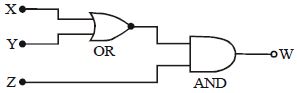
Output $W$ is given by
A direct current of $5\,A$ is superposed on an alternating current $I =10 \sin \omega t$ flowing through the wire. The effective value of the resulting current will be
Two cars are approaching each other at an equal speed of $7.2\, km / hr$. When they see each other, both blow horns having frequency of $676\, Hz$. The beat frequency heard by each driver will be $.....\, Hz$. [Velocity of sound in air is $340\,m / s .]$
An inductance of $1\, mH$ a condenser of $10$ $\mu$ $F$ and a resistance of $50\,  \Omega $ are connected in series. The reactances of inductor and condensers are same. The reactance of either of them will be........$\Omega$
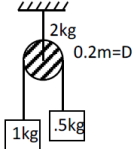
For the given figure find the acceleration of $1\, kg$ block if string is massless and mass of the pulley is $2\, kg$ and diameter of puller is $0.2\, m$ (in $m / s ^{2}$)
Apparatus used to find out the velocity of sound in gas is