Question
A simple harmonic progressive wave is represented by the equation : $y = 8\sin 2\pi (0.1x - 2t)$ where $x$ and $y$ are in $cm$ and $t$ is in seconds. At any instant the phase difference between two particles separated by $2.0 \,cm$ in the $x-$direction is ..... $^o$
Answer

(d) From the given equation $k = 0.2\pi $
==>$\frac{{2\pi }}{\lambda } = 0.2\pi \Rightarrow \lambda = 10\,cm$
$\Delta \phi = \frac{{2\pi }}{\lambda }\,\Delta x = \frac{{2\pi }}{{10}} \times 2 = \frac{{2\pi }}{5} = {72^o}\,$

Need a full question paper?

Generate a complete, print-ready paper with questions like this in minutes — across 16+ boards, with answer keys.

Start Generating Free

Similar questions

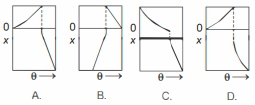
A ray of light originates from inside a glass slab and is incident on its inner surface at an angle $\theta$ as shown below. In this experiment, the location $x$ of the spot where the ray hits the screen is recorded. Which of the following correctly shows the plot of variation of $x$ with the angle $\theta$ ?
Consider three quantities $x = E/B,$ $y =\sqrt {1/{\mu _0}{\varepsilon _0}} $ and $z = l$ . Here, $l$ is the length of a wire, $C$ is a $CR$ capacitance and $R$ is a resistance. All other symbols have standard meanings.
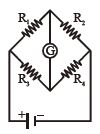
The resistances in $WSB$ circuit shown in the diagram all are different and the current through the galvanometer is zero. If all thermal effects are negligible, the current through the galvanometer will not be zero, when
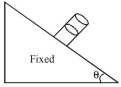
A cylindrical vessel filled with water is released on an inclined surface of angle $\theta$ as shown in figure.The friction coefficient of surface with vessel is $\mu( < \tan \theta)$.Then the contact angle made by the surface of water with the incline will be
$1kWh = $
A string fixed at both ends is in resonance in its $2^{nd}$ harmonic with a tuning fork of frequency $f_1$. Now its one end becomes free. If the frequency of the tuning fork is increased slowly from $f_1$ then again a resonance is obtained when the frequency is $f_2$. If in this case the string vibrates in $n^{th}$ harmonic then
Which of the following function represents a simple harmonic oscillation
Two condensers of capacities $2C$ and $C$ are joined in parallel and charged upto potential $V$. The battery is removed and the condenser of capacity $C$ is filled completely with a medium of dielectric constant $K$. The $p.d.$ across the capacitors will now be
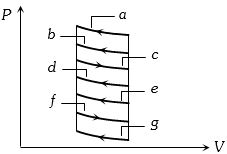
The $P-V$ diagram shows seven curved paths (connected by vertical paths) that can be followed by a gas. Which two of them should be parts of a closed cycle if the net work done by the gas is to be at its maximum value
Charges $4Q$, $q$ and $Q$ and placed along $x$-axis at positions $x = 0,x = l/2$ and $x = l$, respectively. Find the value of $q$ so that force on charge $Q$ is zero