Consider three quantities $x = E/B,$ $y =\sqrt {1/{\mu _0}{\varepsilon _0}} $ and $z = l$ . Here, $l$ is the length of a wire, $C$ is a $CR$ capacitance and $R$ is a resistance. All other symbols have standard meanings.
Medium
Download our app for free and get started

Download our appand get started for free
Experience the future of education. Simply download our apps or reach out to us for more information. Let's shape the future of learning together!No signup needed.*
Similar Questions
- 1View SolutionWhich of the following statements regarding magnetic lines of force is correct?
- 2A charged particle of specific charge $\alpha$ is released from origin at time $t = 0$ with velocity $\vec V = {V_o}\hat i + {V_o}\hat j$ in magnetic field $\vec B = {B_o}\hat i$ . The coordinates of the particle at time $t = \frac{\pi }{{{B_o}\alpha }}$ are (specific charge $\alpha = \,q/m$)View Solution
- 3In a hydrogen atom, an electron of mass $m$ and charge $e$ revolves in an orbit of radius $r$ making $n$ revolutions per second. If the mass of hydrogen nucleus is $M$, the magnetic moment associated with the orbital motion of electron isView Solution
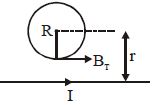
- 4In following diagram there is a straight wire carrying a current $I.$ Consider a circular path with radius $(R)$ near it. It $\vec B_T$ is the tangential component of magnetic field then find the value of integral $\int {{{\vec B}_T}.\overrightarrow {dl} } $View Solution
- 5An electron has mass $9 \times {10^{ - 31}}\,kg$ and charge $1.6 \times {10^{ - 19}}C$ is moving with a velocity of ${10^6}\,m/s$, enters a region where magnetic field exists. If it describes a circle of radius $0.10\, m$, the intensity of magnetic field must beView Solution
- 6A straight wire carrying a current ${i_1}\,amp$ runs along the axis of a circular current ${i_2}\,amp$. Then the force of interaction between the two current carrying conductors isView Solution
- 7When a current of $5\ mA$ is passed through a galvanometer having a coil of resistance $15\ \Omega$, it shows full scale deflection. The value of the resistance to be put in series with the galvanometer to convert it into to voltmeter of range $0 - 10\ V$ isView Solution
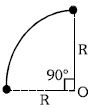
- 8A wire of magnetic moment $M$ is moulded according to figure, then magnetic moment becomesView Solution
- 9A charge $q$ is released in presence of electric $(E)$ and magnetic field $(B)$ then after some time its velocity is $v$ thenView Solution
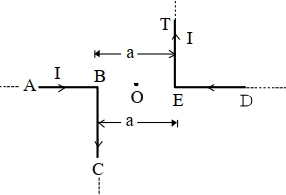
- 10The magnitude of magnetic induction at mid-point $O$ due to current arrangement as shown in Fig will beView Solution