Question
A simple microscope is rated 5 for a normal relaxed eye. What will be its magnifying power for a relaxed farsighted eye whose near point is 40cm?

Answer

The simple microscope has magnification of 5 for normal relaxed eye (D = 25cm).Because, the eye is relaxed the image is formed at infinity (normal adjustment)
So, $\text{m}=5=\frac{\text{D}}{\text{f}}=\frac{25}{\text{f}}\Rightarrow\text{f}=5\text{cm}$
For the relaxed farsighted eye, $\text{D} = 40\text{cm}$
So, $\text{m}=\frac{\text{D}}{\text{f}}=\frac{40}{5}=8$
So, its magnifying power is 8X.

Need a full question paper?

Generate a complete, print-ready paper with questions like this in minutes — across 16+ boards, with answer keys.
Start Generating Free

Similar questions

A brass plate having surface area $200\ cm^2$ on one side is electroplated with $0·10\ mm$ thick silver layers on both sides using a $15A$ current. Find the time taken to do the job. The specific gravity of silver is $10.5$ and its atomic weight is 1$07.9\ g/mol.$
Explain the effect of intersity of light on photocurrent.
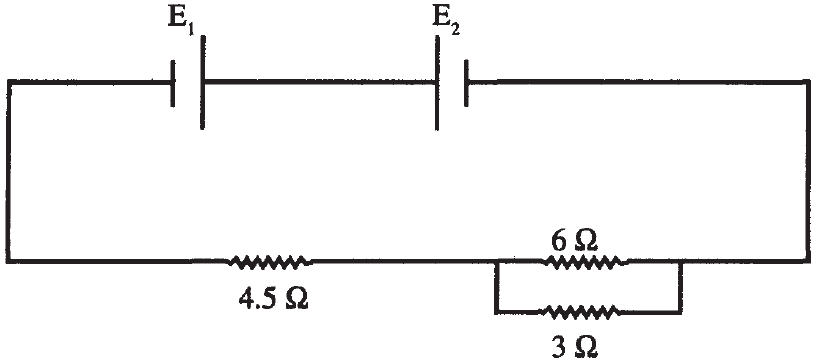
Two cells $E_1$ and $E_2$ in the given circuit diagram have an emf of $5 V$ and $9 V$ and internal resistance of $0.3 \Omega$ and $1.2 \Omega$ respectively.
Calculate the value of current flowing through the resistance of $3 \Omega$.
When three identical capacitors are connected in series, their equivalent (total) capacitance is $1 \mu F$. If they are connected in parallel, what will be their total capacitance? If the capacitors are connected to the same source in both the conditions (combinations), then find the ratio of the stored energy in these two types of combinations.
Suppose you have three resistors of $20\Omega,50\Omega$ and $100\Omega.$ What minimum and maximum resistance can you obtain from these resistors?
Explain the excited states for the hydrogen atom.
State Lenz’s Law.
A metallic rod held horizontally along east-west direction, is allowed to fall under gravity. Will there be an emf induced at its ends? Justify your answer.
What do you mean by diffraction of light ?
Can the voltage drop across the inductor or the capacitor in a series $\text{LCR}$ circuit be greater than the applied voltage of the $a.c$. source? Justify your answer.
Explain the variation of resistivity with temperature in pure-semiconductors.