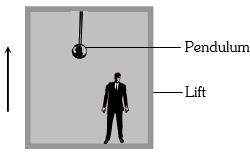
A simple pendulum hanging from the ceiling of a stationary lift has a time period $T_1$. When the lift moves downward with constant velocity, the time period is $T_2$, then
Easy


Download our appand get started for free
Experience the future of education. Simply download our apps or reach out to us for more information. Let's shape the future of learning together!No signup needed.*
Similar Questions
- 1A particle performs $S.H.M.$ of amplitude $A$ with angular frequency $\omega$ along a straight line. Whenit is at a distance $\frac{{\sqrt 3 }}{2}$ $A$ from mean position, its kinetic energy gets increased by an amount $\frac{1}{2}m{\omega ^2}{A^2}$ due to an impulsive force. Then its new amplitude becomesView Solution
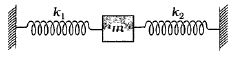
- 2Two springs, of force constants $k_1$ and $k_2$ are connected to a mass $m$ as shown. The frequency of oscillation of the mass is $f$ If both $k_1$ and $k_2$ are made four times their original values, the frequency of oscillation becomesView Solution
- 3A large horizontal surface moves up and down in $SHM$ with an amplitude of $1 \,cm$. If a mass of $10\, kg$ (which is placed on the surface) is to remain continually in contact with it, the maximum frequency of $S.H.M.$ will be ... $Hz$View Solution
- 4The period of oscillation of a mass $M$ suspended from a spring of negligible mass is $T$. If along with it another mass $M$ is also suspended , the period of oscillation will now beView Solution
- 5View SolutionThe total energy of a particle executing simple harmonic motion is
- 6A small body of mass $0.10\, kg$ is executing $S.H.M.$ of amplitude $1.0 \,m$ and period $0.20\, sec$. The maximum force acting on it is.... $N$View Solution
- 7A man measures the period of a simple pendulum inside a stationary lift and finds it to be $T$ sec. If the lift accelerates upwards with an acceleration $\frac{g}{4}$, then the period of the pendulum will beView Solution
- 8A point particle is acted upon by a restoring force $-k x^{3}$. The time-period of oscillation is $T$, when the amplitude is $A$. The time-period for an amplitude $2 A$ will beView Solution
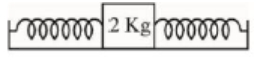
- 9A block of mass $2\,kg$ is attached with two identical springs of spring constant $20\,N / m$ each. The block is placed on a frictionless surface and the ends of the springs are attached to rigid supports (see figure). When the mass is displaced from its equilibrium position, it executes a simple harmonic motion. The time period of oscillation is $\frac{\pi}{\sqrt{x}}$ in SI unit. The value of $x$ is $..........$View Solution
- 10View SolutionWhen the displacement is half the amplitude, the ratio of potential energy to the total energy is