MCQ
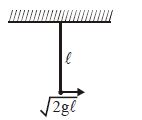
A simple pendulum having length $\ell $ is having speed  $\sqrt {2g\ell }$ at bottom most point of its trajectory. Its motion will be
  • Periodic but not  $SHM$
  • B
    Periodic as well as  $SHM$
  • C
    Neither periodic nor $SHM$
  • D
    Not periodic but  $SHM$

Answer

Correct option: A.
Periodic but not  $SHM$
a
Particle will just complete half of the circle, so periodic but not  $S.H.M.$

Need a full question paper?

Generate a complete, print-ready paper with questions like this in minutes — across 16+ boards, with answer keys.

Start Generating Free

Similar questions

The speed of sound in air is independent from its
A clay ball of mass $m$ and speed $v$ strikes another metal ball of same mass $m$, which is at rest. They stick together after collision. The kinetic energy of the system after collision is
Physical independence of force is a consequence of:
A particle is confined to rotate in a circular path decreasing linear speed, then which of the following is correct?
Water flows into a cylindrical vessel of large cross-sectional area at a rate of $10^{-4}$ $m^3/s$. It flows out from a hole of area $10^{-4}$ $m^2$, which has been punched through the base. How high does the water rise in the vessel?
A particle of mass $M,$ starting from rest , undergoes uniform acceleration. If the speed acquired in time $T$ is $V,$ the power delivered to the particle is
The frequency of vibration of string is given by $\nu = \frac{p}{{2l}}{\left[ {\frac{F}{m}} \right]^{1/2}}$. Here $p$ is number of segments in the string and $l$ is the length. The dimensional formula for $m$ will be
At any instant, the velocity and acceleration of a particle moving along a straight line are $v$ and $a$. The speed of the particle is increasing if
The fundamental frequency of a vibrating organ pipe is $200Hz.$
A uniformly tapering conical wire is made from a material of Young's modulus $Y$  and has a normal, unextended length $L.$ The radii, at the upper and lower ends of this conical wire, have values $R$ and $3R,$  respectively. The upper end of the wire is fixed to a rigid support and a mass $M$ is suspended from its lower end. The equilibrium extended length, of this wire, would equal