A simple pendulum is attached to the roof of a lift. If time period of oscillation, when the lift is stationary is $T$. Then frequency of oscillation, when the lift falls freely, will be
Easy
Download our app for free and get started
(a) When lift falls freely effective acceleration and frequency of oscillations be zero
${g_{eff}} = 0$ $⇒$ $T' = \infty $, hence a frequency $= 0.$
${g_{eff}} = 0$ $⇒$ $T' = \infty $, hence a frequency $= 0.$

Download our appand get started for free
Experience the future of education. Simply download our apps or reach out to us for more information. Let's shape the future of learning together!No signup needed.*
Similar Questions
- 1Two simple pendulum first of bob mass $M_1$ and length $L_1$ second of bob mass $M_2$ and length $L_2$. $M_1 = M_2$ and $L_1 = 2L_2$. If these vibrational energy of both is same. Then which is correctView Solution
- 2Two masses ${m_1}$ and ${m_2}$ are suspended together by a massless spring of constant k. When the masses are in equilibrium, ${m_1}$ is removed without disturbing the system. Then the angular frequency of oscillation of ${m_2}$ isView Solution
- 3A particle of mass m is executing oscillations about the origin on the $X-$axis. Its potential energy is $U(x) = k{[x]^3}$, where $k$ is a positive constant. If the amplitude of oscillation is $a$, then its time period $T$ isView Solution
- 4Consider the following statements. The total energy of a particle executing simple harmonic motion depends on itsView Solution
$(1)$ Amplitude $(2) $ Period $(3)$ Displacement
Of these statements
- 5View SolutionWhich of the following expressions represent simple harmonic motion
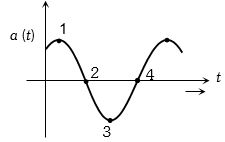
- 6The acceleration $a$ of a particle undergoing $S.H.M.$ is shown in the figure. Which of the labelled points corresponds to the particle being at -$x_{max}$View Solution
- 7A spring of force constant $k$ is cut into lengths of ratio $1:2:3$ . They are connected in series and the new force constant is $k'$ . Then they are connected in parallel and force constant is $k''$ . Then $k':k''$ isView Solution
- 8Two particles are performing simple harmonic motion in a straight line about the same equilibrium point. The amplitude and time period for both particles are same and equal to $A$ and $T,$ respectively. At time $t=0$ one particle has displacement $A$ while the other one has displacement $\frac {-A}{2}$ and they are moving towards each other. If they cross each other at time $t,$ then $t$ isView Solution
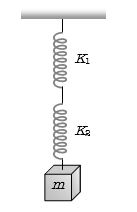
- 9A mass $M$ is suspended by two springs of force constants $K_1$ and $K_2$ respectively as shown in the diagram. The total elongation (stretch) of the two springs isView Solution
- 10The displacement $x$ (in metre) of a particle in, simple harmonic motion is related to time t (in seconds) asView Solution
$x = 0.01\cos \left( {\pi \,t + \frac{\pi }{4}} \right)$
The frequency of the motion will be