Two simple pendulum first of bob mass $M_1$ and length $L_1$ second of bob mass $M_2$ and length $L_2$. $M_1 = M_2$ and $L_1 = 2L_2$. If these vibrational energy of both is same. Then which is correct
Medium
Download our app for free and get started
(b) $n = \frac{1}{{2\pi }}\sqrt {\frac{g}{l}} $==> $n \propto \frac{1}{{\sqrt l }}$==> $\frac{{{n_1}}}{{{n_2}}} = \sqrt {\frac{{{l_2}}}{{{l_1}}}} = \sqrt {\frac{{{L_2}}}{{2{L_2}}}} $
==> $\frac{{{n_1}}}{{{n_2}}} = \frac{1}{{\sqrt 2 }}$==> ${n_2} = \sqrt 2 \,{n_1}$ ==> ${n_2} > {n_1}$
Energy $E = \frac{1}{2}m{\omega ^2}{a^2} = 2{\pi ^2}m{n^2}{a^2}$
==>$\frac{{a_1^2}}{{a_2^2}} = \frac{{{m_2}n_2^2}}{{{m_1}n_1^2}}$ ( $E$ is same)
Given ${n_2} > {n_1}$ and ${m_1} = {m_2}$ ==> ${a_1} > {a_2}$

Download our appand get started for free
Experience the future of education. Simply download our apps or reach out to us for more information. Let's shape the future of learning together!No signup needed.*
Similar Questions
- 1View SolutionA pendulum is swinging in an elevator. Its period will be greatest when the elevator is
- 2A block with mass $M$ is connected by a massless spring with stiffiess constant $k$ to a rigid wall and moves without friction on a horizontal surface. The block oscillates with small amplitude $A$ about an equilibrium position $x_0$. Consider two cases: ($i$) when the block is at $x_0$; and ($ii$) when the block is at $x=x_0+A$. In both the cases, a perticle with mass $m$ is placed on the mass $M$ ?View Solution
($A$) The amplitude of oscillation in the first case changes by a factor of $\sqrt{\frac{M}{m+M}}$, whereas in the second case it remains unchanged
($B$) The final time period of oscillation in both the cases is same
($C$) The total energy decreases in both the cases
($D$) The instantaneous speed at $x_0$ of the combined masses decreases in both the cases
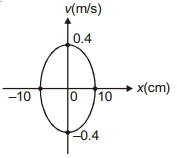
- 3The plot of velocity $(v)$ versus displacement $(x)$ of a particle executing simple harmonic motion is shown in figure. The time period of oscillation of particle is .........View Solution
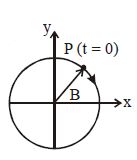
- 4Figure shows the circular motion of a particle. The radius of the circle, the period, sense of revolution and the initial position are indicated on the figure. The simple harmonic motion of the $x-$ projection of the radius vector of the rotating particle $P$ isView Solution
- 5Two massless springs with spring constants $2\,k$ and $2\,k$, carry $50\, g$ and $100 \,g$ masses at their free ends. These two masses oscillate vertically such that their maximum velocities are equal. Then, the ratio of their respective amplitudes will beView Solution
- 6View SolutionA second's pendulum is mounted in a rocket. Its period of oscillation decreases when the rocket
- 7Two springs have spring constants ${K_A}$ and ${K_B}$ and ${K_A} > {K_B}$. The work required to stretch them by same extension will beView Solution
- 8When a mass $M$ is attached to the spring of force constant $k$, then the spring stretches by $l$. If the mass oscillates with amplitude $l$, what will be maximum potential energy stored in the springView Solution
- 9The time period of oscillations of a simple pendulum is $1$ minute. If its length is increased by $44 \%$. then its new time period of oscillation will be ......... $s$View Solution
- 10View SolutionIdentify the function which represents a nonperiodic motion.