Question
Define resonance. Explain resonant frequency and write characteristics of resonant circuit.
Answer

SELF

Need a full question paper?

Generate a complete, print-ready paper with questions like this in minutes — across 16+ boards, with answer keys.

Start Generating Free

Similar questions

Explain with a neat diagram construction and working of a compound microscope. Obtain an expression for its magnifying power.
Use the mirror equation to deduce that:
  1. an object placed between f and 2f of a concave mirror produces a real image beyond 2f.
  2. a convex mirror always produces a virtual image independent of the location of the object.
  3. the virtual image produced by a convex mirror is always diminished in size and is located between the focus and the pole.
The temperatures of equal masses of three different liquids $A, B$ and $C$ are $12^\circ C, 19^\circ C$ and $28^\circ C$ respectively. The temperature when $A$ and $B$ are mixed is $16^\circ C,$ and when $B$ and $C$ are mixed, it is $23^\circ C$. What will be the temperature when $A$ and $C$ are mixed?
Let us list some of the factors, which could possibly influence the speed of wave propagation:
  1. Nature of the source.
  2. Direction of propagation.
  3. Motion of the source and/or observer.
  4. Wavelength.
  5. Intensity of the wave.
On which of these factors, if any, does
  1. The speed of light in vacuum,
  2. The speed of light in a medium (say, glass or water), depend?
Two convex lenses, each of focal length $10\ cm$, are placed at a separation of $15\ cm$ with their principal axes coinciding,
  1. Show that a light beam coming parallel to the principal axis diverges as it comes out of the lens system.
  2. Find the location of the virtual image formed by the lens system of an object placed far away.
  3. Find the focal length of the equivalent lens.
$($Note that the sign of the focal length is positive although the lens system actually diverges a parallel beam incident on it$).$
One mole of an ideal gas undergoes a process $\text{p}=\frac{\text{p}_0}{1+\Big(\frac{\text{V}}{\text{V}_0}\Big)^2}$ where $P_0$ and $V_0$ are constants. Find the temperature of the gas when $V = V_0$.
Oxygen is filled in a closed metal jar of volume $1.0 \times 10^{-3}m^3$ at a pressure of $1.5 \times 10^5Pa$ and temperature $400K$ The jar has a small leak in it. The atmospheric pressure is $1.0 \times 10^5Pa$ and the atmospheric temperature is $300K$ Find the mass of the gas that leaks out by the time the pressure and the temperature inside the jar equalise with the surrounding.
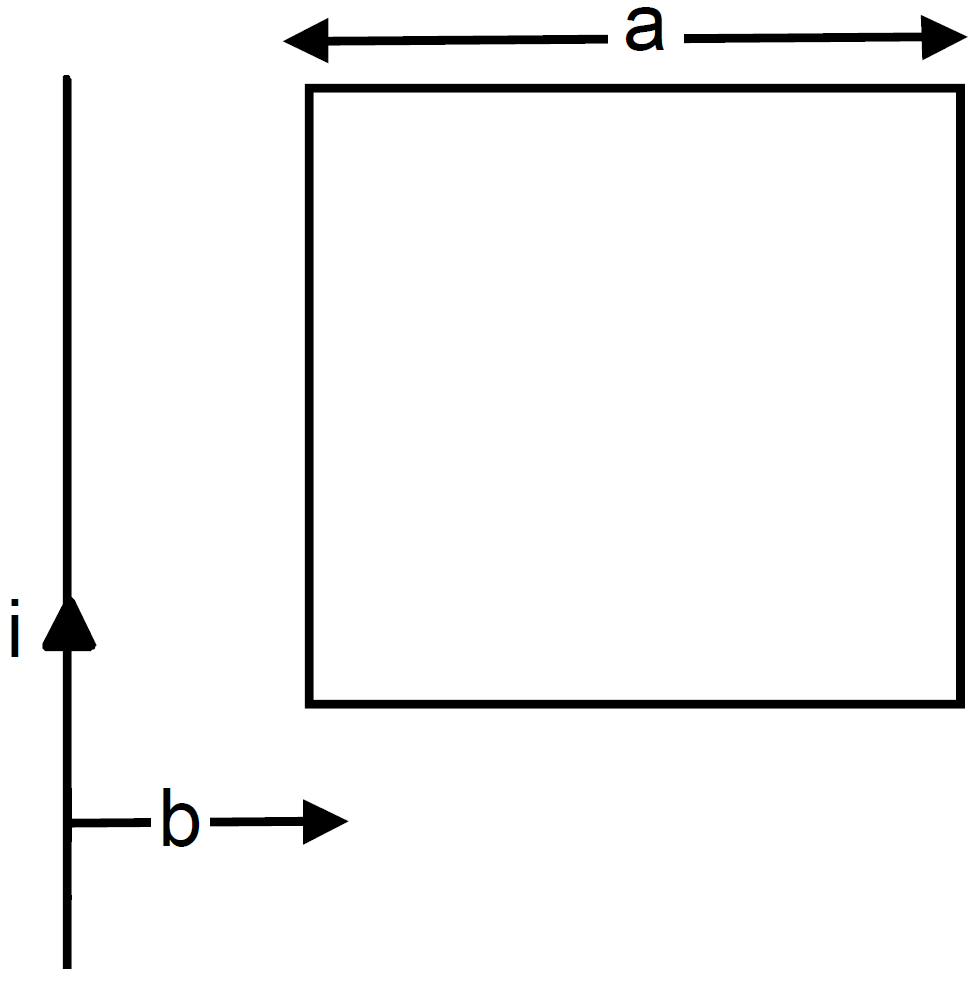
Find the mutual inductance between the straight wire and the square loop of figure.
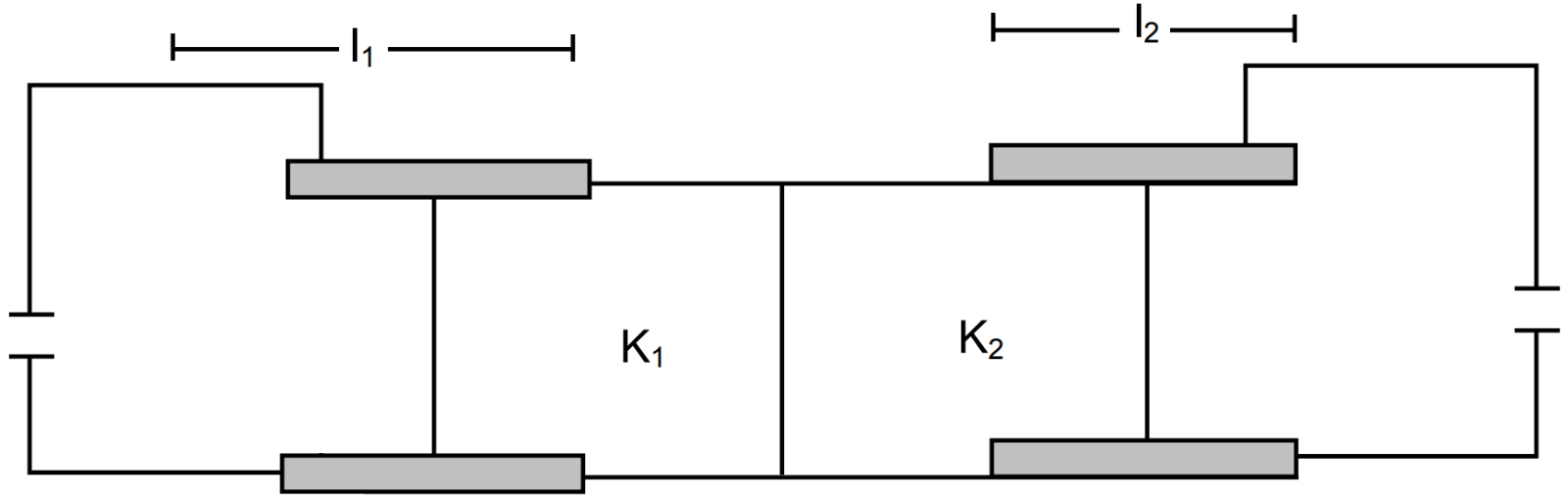
Figure shows two parallel plate capacitors with fixed plates and connected to two batteries. The separation between the plates is the same for the two capacitors. The plates are rectangular in shape with width b and lengths $l_1$ and $l_2$ The left half of the dielectric slab has a dielectric constant $K_1$ and the right half $K_2$. Neglecting any friction, find the ratio of the emf of the left. battery to that of the right battery for which the dielectric slab may remain in equilibrium.
A magnetic field of $(4.0\times10^{-3}\vec{\text{k}})$ T exerts a force of $(4.0\vec{\text{i}}+3.0\vec{\text{j}})\times10^{-10}$ N on a particle with a charge of $1.0\times10^{-9}\text{C}$ and going in the x−y plane. Find the velocity of the particle.