Question
A gas in equilibrium has uniform density and pressure throughout its volume. This is strictly true only if there are no external influences. A gas column under gravity, for example, does not have uniform density (and pressure). As you might expect, its density decreases with height. The precise dependence is given by the so-called law of atmospheres:
$\text{n}_2=\text{n}_1\text{exp}\Big[\frac{-\text{mg}}{\text{k}_\text{B}\text{T}}(\text{h}_2-\text{h}_1)\Big]$
where n2, n1 refer to number density at heights h2 and h1 respectively. Use this relation to derive the equation for sedimentation equilibrium of a suspension in a liquid column:
$\text{n}_2=\text{n}_1\text{exp}\Big[\frac{-\text{mgN}_\text{A}(\rho-\rho')(\text{h}_2-\text{h}_1)}{(\rho\text{RT})}\Big]$
where $\rho$ is the density of the suspended particle, and $\rho'$ that of surrounding medium. [NA is Avogadro’s number, and R the universal gas constant]
[Hint: Use Archimedes principle to find the apparent weight of the suspended particle]
Answer

Considering the particles and molecules to be spherical, the weight of the particle is
$\text{W}=\text{mg}=\frac{4}{3}\pi\text{r}^3\rho\text{g}\ ...(\text{i})$
Where r = radius of the particle and $\rho=$ density of the particle. Its motion under gravity causes buoyant force to act upward which is equal to
B = Volume of particle × fensity of the surrounding medium × g
$=\frac{4}{3}\pi\text{r}^3\rho'\text{g}\ ...(\text{ii})$
 If F be the downward force acting on the particle, then
 $\text{F}=\text{W}-\text{B}=\frac{4}{3}\pi\text{r}^3(\rho-\rho')\text{g}\ ...(\text{iii})$
Also $\text{n}_2=\text{n}_1\text{exp}\Big[\frac{-\text{mg}}{\text{k}_\text{B}\text{T}}(\text{h}_2-\text{h}_1)\Big]\ ...(\text{iv})$
Where KB = Boltzman constant
n1 and n2 are number densities at heights h1 and h2 respectively. Here, mg can be replaced by effective force F given by equation (iii)
$\therefore$ From (iii) and (iv) we get
$\text{n}_2=\text{n}_1\text{exp}\Big[-\frac{4\pi}{3}\text{r}^3\frac{(\rho-\rho')}{\text{k}_\text{B}\text{T}}\text{g}(\text{h}_2-\text{h}_1)\Big]$
$\text{n}_2=\text{n}_1\text{exp}\Bigg[-\frac{4\pi}{3}\text{r}^3\frac{\rho\text{g}\big(1-\frac{\rho'}{\rho}\big)(\text{h}_2-\text{h}_1)}{\big(\frac{\text{RT}}{\text{N}_\text{A}}\big)}\Bigg]$ $\Big[\because\text{ k}_\text{B}=\frac{\text{R}}{\text{N}_\text{A}}\Big]$
$\text{n}_2=\text{n}_1\text{exp}\Bigg[-\frac{\text{mgN}_\text{A}\big(1-\frac{\rho'}{\rho}\big)(\text{h}_2-\text{h}_1)}{\text{RT}}\Bigg]$
Which is required relation where, $\frac{4}{3}\pi\text{r}^3\rho\text{g}=$ mass of the particle × g = mg

Need a full question paper?

Generate a complete, print-ready paper with questions like this in minutes — across 16+ boards, with answer keys.

Start Generating Free

Similar questions

The free surface of oil in a tanker, at rest, is horizontal. If the tanker starts accelerating the free surface will be titled by an angle $\theta.$ If the acceleration is a m s-2, what will be the slope of the free surface?
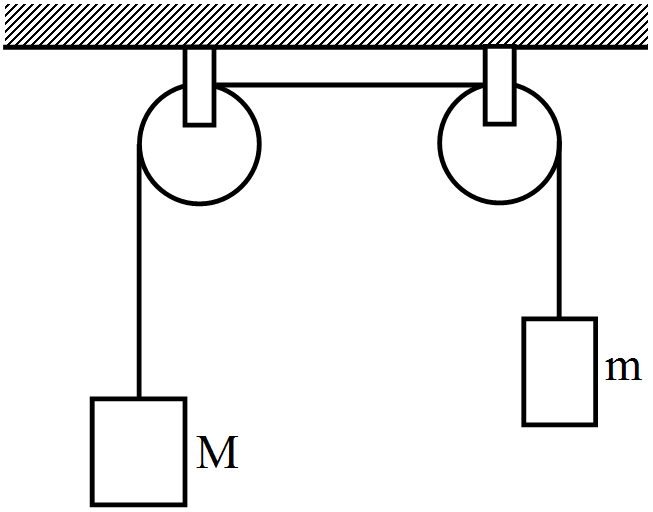
The pulleys in figure are identical, each having a radius R and moment of inertia I. Find the acceleration of the block M.

Prove that the velocity v of translation of a rolling body (like a ring, disc, cylinder or sphere) at the bottom of an inclined plane of height h is given by:

$\text{v}^2=\frac{2\text{gh}}{\big(1+\frac{\text{K}^2}{\text{R}^2}\big)}$

Note K is the radius of gyration of the body about its symmetry axis, and R is the radius of the body. The body starts from rest at the top of the plane.

Two particles A and B, each carrying a charge Q, are held fixed with a separation d between them. A particle C having mass m and charge q is kept at the middle point of the line AB.
  1. If it is displaced through a distance x perpendicular to AB, what would be the electric force experienced by it.
  2. Assuming x << d, show that this force is proportional to x.
  3. Under what conditions will the particle C execute simple harmonic motion if it is released after such a small displacement?
Find the time period of the oscillations if these conditions are satisfied.
Let us assume that our galaxy consists of 2.5 × 10¹¹ stars each of one solar mass. How long will a star at a distance of 50,000ly from the galactic centre take to complete one revolution? Take the diameter of the Milky Way to be 105ly.
A thermally insulated, closed copper vessel contains water at 15°C. When the vessel is shaken vigorously for 15 minutes, the temperature rises to l 7°C. The .mass of the vessel is 100g and that of the water is 200g. The specific heat capacities of copper and water are 420Jkg-1 K-1 and 4200Jkg-1 K-1 respectively. Neglect any thermal expansion.
  1. How much heat is transferred to the liquid-vessel system?
  2. How much work has been done on this system?
  3. How much is the increase in internal energy of the system?
A mass attached to a spring is free to oscillate, with angular velocity $\omega,$ in a horizontal plane without friction or damping. It is pulled to a distance x0 and pushed towards the centre with a velocity $\upsilon_0$ at time t = 0. Determine the amplitude of the resulting oscillations in terms of the parameters $\omega,$ x0 and $\upsilon_0.$ [Hint: Start with the equation $\text{x}=\text{a}\cos(\omega\text{t}+\theta)$ and note that the initial velocity is negative.]
A train, standing at the outer signal of a railway station blows a whistle of frequency 400Hz in still air.
  1. What is the frequency of the whistle for a platform observer when the train (a) approaches the platform with a speed of 10m s–1, (b) recedes from the platform with a speed of 10m s–1?
  2. What is the speed of sound in each case? The speed of sound in still air can be taken as 340m s–1.
A spaceship is stationed on Mars. How much energy must be expended on the spaceship to launch it out of the solar system? Mass of the space ship = 1000kg; mass of the sun = 2 × 1030kg; mass of mars = 6.4 × 10²³kg; radius of mars = 3395km; radius of the orbit of mars = 2.28 × 10⁸km; G = 6.67 × 10⁻¹¹N m2 kg-2.
Free-fall : Discuss the motion of an object under free fall. Neglect air resistance.