MCQ
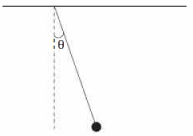
A simple pendulum is released from rest at the horizontally stretched position. When the string makes an angle $\theta$ with the vertical, the angle $\phi$ which the acceleration vector of the bob makes with the string is given by
  • A
    $\phi=0$
  • $\phi=\tan ^{-1}\left(\frac{\tan \theta}{2}\right)$
  • C
    $\phi=\tan ^{-1}(2 \tan \theta)$
  • D
    $\phi=\frac{\pi}{2}$

Answer

Correct option: B.
$\phi=\tan ^{-1}\left(\frac{\tan \theta}{2}\right)$
b
(b)

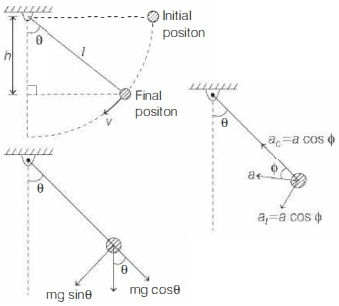
Let $v$ is the velocity of bob at position $\theta$ after being released from horizontal position.

From energy conservation, we have

$m g h=\frac{1}{2} m v^2$

$\Rightarrow m g(l \cos \theta)=\frac{1}{2} m v^2$

$\Rightarrow \quad \frac{v^2}{l}=2 g \cos \theta \quad \dots(i)$

Restoring force on bob is component of weight.

So, tangential component of acceleration is

$a_t=g \sin \theta \quad \dots(ii)$

If total acceleration a makes angle $\phi$ with string. Then,

Tangential component,

$a_t=a \sin \phi$

and radial component, $a_c=a \cos \phi$

So, $\quad \frac{a_t}{a_c}=\frac{a \sin \phi}{a \cos \phi}=\tan \phi$

$\Rightarrow \quad \tan \phi=\frac{a_i}{a_c} \quad \dots(iii)$

Substituting values of $a_t$ and $a_c$ from Eqs.

$(i)$ and $(ii)$ in Eq. $(iii)$, we get

$\tan \phi=\frac{g \sin \theta}{2 g \cos \theta}$

$\Rightarrow \quad \tan \phi=\frac{\tan \theta}{2}$

So, $\quad \phi=\tan ^{-1}\left(\frac{\tan \theta}{2}\right)$
Need a full question paper?

Generate a complete, print-ready paper with questions like this in minutes — across 16+ boards, with answer keys.

Start Generating Free

Similar questions

Ratio of the amount of heat radiation, transmitted through the body to the amount of heat radiation incident on it, is known as
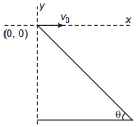
A man standing on a hill top projects a stone horizontally with speed $v_0$ as shown in figure. Taking the coordinates system as given in the figure. The coordinates of the point, where the stone will hit the hill surface are
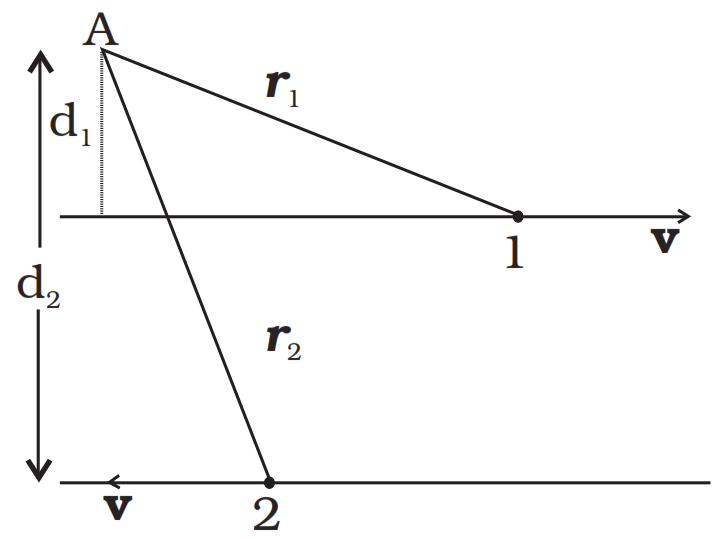
Shows two identical particles 1 and 2, each of mass m, moving in opposite directions with same speed v along parallel lines. At a particular instant, r1 and r2 are their respective position vectors drawn from point A which is in the plane of the parallel lines . Choose the correct options:

The speed of light depends:
  1. On elasticity of the medium only.
  2. On inertia of the medium only.
  3. On elasticity as well as inertia.
  4. Neither on elasticity nor on inertia.
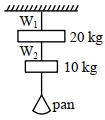
Wires ${W}_{1}$ and ${W}_{2}$ are made of same material having the breaking stress of $1.25 \times 10^{9} \,{N} / {m}^{2}$ ${W}_{1}$ and ${W}_{2}$ have cross-sectional area of $8 \times 10^{-7}\, {m}^{2}$ and $4 \times 10^{-7}\, {m}^{2}$, respectively. Masses of $20 \,{kg}$ and $10\, {kg}$ hang from them as shown in the figure. The maximum mass that can be placed in the pan without breaking the wires is $.....{kg}$ (Use $\left.{g}=10\, {m} / {s}^{2}\right)$
Two waves having the intensities in the ratio of $9 : 1$ produce interference. The ratio of maximum to the minimum intensity, is equal to
Figure shows a closed surface which intersects a conducting sphere. If a positive charged is placed at the point P, the flux of the electic field through the closed surface:

  1. Will remain zero.
  2. Will become positive.
  3. Will become neagative.
  4. Will become undefined.
During capillary rise of a liquid in a capillary tube, the surface of contact that remains constant is of
The motion of a particle is described by the equation $x = a + b{t^2}$ where $a = 15\, cm$ and $b = 3 \,cm/s^2$. Its instantaneous velocity at time $3\, sec$ will be........$cm/sec$
A long spring is stretched by 2cm. Its potential energy is V. If the spring is stretched by 10cm, its potential energy would be: