MCQ
A simple pendulum suspended from the ceiling of a stationary lift has period $T_0$. When the lift descends at steady speed, the period is $T_1$, and when it descends with constant downward acceleration, the period is $T_2$. Which one of the following is true?
  • A
    $T_0=T_1=T_2$
  • $T_0=T_1$
  • C
    $T_0=T_1 > T_2$
  • D
    $T_0 < T_1 < T_2$

Answer

Correct option: B.
$T_0=T_1$
b
(b)

Pseudo force only when there is an acceleration.

Hence $T_0=T_1$ as there is uniform downward motion.

When it moves downward with a steady acceleration then pseudo force acts upwards, reducing net ' $g$ '

Since $T_2=2 \pi \sqrt{\frac{1}{g_{\text {net }}}}$

When $g$ reduces time period $T_2$ increases

$T_0=T_1 < T_2$

Need a full question paper?

Generate a complete, print-ready paper with questions like this in minutes — across 16+ boards, with answer keys.

Start Generating Free

Similar questions

A vertical hanging bar of length $l$ and mass $m$ per unit length carries a load of mass $M$ at lower end, its upper end is clamped to a rigid support. The tensile stress a distance $x$ from support is $(A \rightarrow$ area of cross-section of bar)
One mole of ideal gas required $207J$ heat to rise the temperature by $10^\circ K$ when heated at constant pressure. If the same gas is heated at constant volume to raise the temperature by the same $10^\circ K$ the heat required is $(R = 8/ 3J/ \text{mole}^\circ \text{K})$
A person draws water from a $5\,m$ deep well in a bucket of mass $2\,kg$ of capacity $8\,litre$ by a rope of mass $1\,kg.$ What is the total work done by the person ? .............. $\mathrm{J}$ (Assume $g = 10\,m/sec^2$ )
A body of mass $m$ kg. starts falling from a point $2R$ above the Earth’s surface. Its kinetic energy when it has fallen to a point $‘R’$ above the Earth’s surface [$R-$Radius of Earth, $M-$Mass of Earth, $G-$Gravitational Constant]
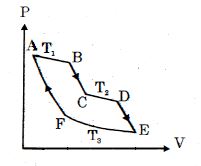
One mole of ideal gas taken through a cycle process with alternate isothermal and adiabatic curves. In $P-V$ diagram $AB, CD, EF$ are isothermal curves at the absolute temperature $T_1, T_2$ and $T_3$ respectively and $BC, DE$ and $FA$ are adiabatic curves respectively. If $\frac{{{V_B}}}{{{V_A}}} = 2,\,\frac{{{V_D}}}{{{V_C}}} = 2$ then for cycle is shown in figure four statements are being made given below. (Figure is not drawn on scale) 

Statement $1$ : Ratio of volumes $\frac{{{V_E}}}{{{V_F}}} = 4$

Statement $2$ : Magnitude of work done in isothermal compression $EF$ is $2RT_3\ ln\ (2)$

Statement $3$ : Ratio of heat supplied to gas in the process $AB$ to heat rejected by gas in process $EF$ is $\frac{{{T_1}}}{{2{T_3}}}$

Statement $4$ : Net work done by gas in the cycle $ABCDEFA$ is $(T_1 + T_2 - 2T_3) R\  ln\ (2)$ 

Find the number of correct statement $(s)$ given for the cyclic process followed by gas

A wire of length $50\, cm$ and cross sectional area of $1$ sq. mm is extended by $1\, mm.$ The required work will be      $(Y = 2 \times {10^{10}}\,N{m^{ - 2}})$
What does not change in the field of central force
A pendulum clock (fitted with a small heavy bob that is connected with a metal rod) is $5\, seconds$ fast each day at a temperature of $15\,^oC$ and $10\,seconds$ slow at a temperature of $30\,^oC$. The temperature at which it is designed to give correct time, is ........ $^oC$
Match List$-I$ with List$-II.$

List$-I$ List$-II$
$(a)$ Torque $(i)$ ${MLT}^{-1}$
$(b)$ Impulse $(ii)$ ${MT}^{-2}$
$(c)$ Tension $(iii)$ ${ML}^{2} {T}^{-2}$
$(d)$ Surface Tension $(iv)$ ${MI} {T}^{-2}$

Choose the most appropriate answer from the option given below :

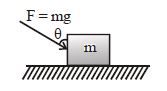
The force acting on the block pushes it, then pushing of the block will be possible along the surface if