A simple pendulum with a metallic bob has a time period $T$. The bob is now immersed in a non-viscous liquid and oscillated. If the density of the liquid is $1 / 4$ that of metal, the time period of the same pendulum will be ...........
Medium


Download our appand get started for free
Experience the future of education. Simply download our apps or reach out to us for more information. Let's shape the future of learning together!No signup needed.*
Similar Questions
- 1A particle is excuting a simple harmonic motion. Its maximum acceleration is $\alpha $ and maximum velocity is $\beta $. Then its frequency of vibration will beView Solution
- 2$A$ particle of mass m is constrained to move on $x$ -axis. $A$ force $F$ acts on the particle. $F$ always points toward the position labeled $E$. For example, when the particle is to the left of $E, F$ points to the right. The magnitude of $F$ is a constant $F$ except at point $E$ where it is zero. The system is horizontal. $F$ is the net force acting on the particle. The particle is displaced a distance $A$ towards left from the equilibrium position $E$ and released from rest at $t = 0.$ Find minimum time it will take to reach from $x = - \frac{A}{2}$ to $0$.View Solution
- 3A body of mass $5\, gm$ is executing $S.H.M.$ about a point with amplitude $10 \,cm$. Its maximum velocity is $100\, cm/sec$. Its velocity will be $50\, cm/sec$ at a distanceView Solution
- 4View SolutionIdentify the correct statement
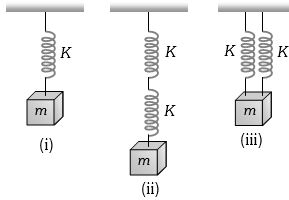
- 5View SolutionFive identical springs are used in the following three configurations. The time periods of vertical oscillations in configurations (i), (ii) and (iii) are in the ratio
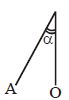
- 6Time period of a simple pendulum is $T$. The angular displacement for amplitude is $\beta$. How much time the bob of pendulum will take to move from equilibrium position $O$ to $A$, making an angle $\alpha$ at the supportView Solution
- 7The equation of an $S.H.M.$ with amplitude $A$ and angular frequency $\omega$ in which all the distances are measured from one extreme position and time is taken to be zero at the other extreme position is ...View Solution
- 8The displacement of a particle executing SHM is given by $x=10 \sin \left(\omega t+\frac{\pi}{3}\right) \mathrm{m}$. The time period of motion is $3.14 \mathrm{~s}$. The velocity of the particle at $\mathrm{t}=0$is_________. $\mathrm{m} / \mathrm{s}$.View Solution
- 9View SolutionThe total energy of a particle executing S.H.M. is proportional to
- 10$Assertion :$ In $SHM$, acceleration is always directed towards the mean position.View Solution
$Reason :$ In $SHM$, the body has to stop momentary at the extreme position and move back to mean position.