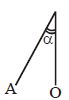
Time period of a simple pendulum is $T$. The angular displacement for amplitude is $\beta$. How much time the bob of pendulum will take to move from equilibrium position $O$ to $A$, making an angle $\alpha$ at the support
  • A$T\,{\sin ^{ - 1}}\left( {\frac{\alpha }{\beta }} \right)$
  • B$T\,{\sin ^{ - 1}}\left( {\frac{\beta }{\alpha }} \right)$
  • C$\frac{T}{2\pi }\,{\sin ^{ - 1}}\left( {\frac{\alpha }{\beta }} \right)$
  • D$\frac{T}{\pi }\,{\sin ^{ - 1}}\left( {\frac{\alpha }{\beta }} \right)$
Diffcult
art

Download our app
and get started for free

Experience the future of education. Simply download our apps or reach out to us for more information. Let's shape the future of learning together!No signup needed.*

Similar Questions

  • 1
    Figure shows the circular motion of a particle. The radius of the circle, the period, sense of revolution and the initial position are indicated in the figure. The simple harmonic motion of the $x-$ projection of the radius vector of the rotating particle $P$ is
    View Solution
  • 2
    The bob of a pendulum was released from a horizontal position. The length of the pendulum is $10 \mathrm{~m}$. If it dissipates $10 \%$ of its initial energy against air resistance, the speed with which the bob arrives at the lowest point is : [Use, $\mathrm{g}: 10 \mathrm{~ms}^{-2}$ ]
    View Solution
  • 3
    Abody performs simple harmonic oscillations along the straight line $ABCDE$ with $C$ as the midpoint of $AE.$ Its kinetic energies at $B$ and $D$ are each one fourth of its maximum value. If $AE = 2R,$ the distance between $B$ and $D$ is
    View Solution
  • 4
    A body executing simple harmonic motion has a maximum acceleration equal to $ 24\,metres/se{c^2} $ and maximum velocity equal to $ 16\;metres/sec $. The amplitude of the simple harmonic motion is
    View Solution
  • 5
    The total mechanical energy of a particle in $SHM$ is
    View Solution
  • 6
    Two particles are performing simple harmonic motion in a straight line about the same equilibrium point. The amplitude and time period for both particles are same and equal to $A$ and $T,$  respectively. At time $t=0$ one particle has displacement $A$ while the other one has displacement $\frac {-A}{2}$ and they are moving towards each other. If they cross each other at time $t,$ then $t$ is
    View Solution
  • 7
    The total energy of a particle executing $S.H.M.$ is $80 \,J$. What is the potential energy when the particle is at a distance of $\frac{3}{4}$ of amplitude from the mean position..... $J$
    View Solution
  • 8
    Average velocity of a particle executing $SHM$ in one complete vibration is 
    View Solution
  • 9
    The potential energy of a particle of mass $100 \,g$ moving along $x$-axis is given by $U=5 x(x-4)$, where $x$ is in metre. The period of oscillation is .................
    View Solution
  • 10
    A particle executes $SHM$ on a straight line path. The amplitude of oscillation is $2\, cm.$ When the displacement of the particle from the mean position is $1\, cm,$ the numerical value of magnitude of acceleration is equal to the numerical value of magnitude of velocity. The frequency of $SHM$ (in $second^{-1}$) is :
    View Solution