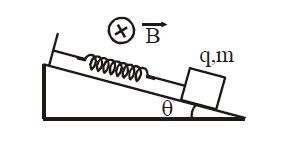
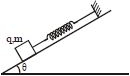
A small block of mass $m$, having charge $q$ is placed on frictionless inclined plane making an angle $\theta$ with the horizontal. There exists a uniform magnetic field $B$ parallel to the inclined plane but perpendicular to the length of spring. If $m$ is slightly pulled on the inclined in downward direction and released, the time period of oscillation will be (assume that the block does not leave contact with the plane)
Medium


Download our appand get started for free
Experience the future of education. Simply download our apps or reach out to us for more information. Let's shape the future of learning together!No signup needed.*
Similar Questions
- 1A long solenoid has $200$ turns per cm and carries a current of $2.5\, amps$. The magnetic field at its centre is $({\mu _0} = 4\pi \times {10^{ - 7}}\,weber/amp{\rm{ - }}m)$View Solution
- 2Two ions of masses $4 \,{amu}$ and $16\, amu$ have charges $+2 {e}$ and $+3 {e}$ respectively. These ions pass through the region of constant perpendicular magnetic field. The kinetic energy of both ions is same. Then :View Solution
- 3$20$ $ampere$ current is flowing in a long straight wire. The intensity of magnetic field at a distance $20\, cm$ from the wire will beView Solution
- 4A coil having $N$ turns is wound tightly in the form of a spiral with inner and outer radii $a$ and $b$ respectively. When a current $i$ passes through the coil, the magnetic field at the centre isView Solution
- 5A long solenoid has $200$ $turns$ per $cm$ and carries a current $i$. The magnetic field at its centre is $6.28 \times 10^{-2} $ $\frac{{Wb}}{{{m^2}}}$ Another long solenoid has $100$ $turns$ per $cm$ and it carries a current $\frac{I}{3}\;$ . The value of the magnetic field at its centre isView Solution
- 6An alternating electric field, of frequency $f$, is applied across the dees $(\, radius \,\approx\, R)$ of a cyclotron that is being used to accelerate protons $(\,mass \,\approx \, m).$ The operating magnetic field $(B)$ used in the cyclotron and the kinetic energy $(K)$ of the proton beam, produced by it, are given byView Solution
- 7A charge $Q$ is uniformly distributed over the surface of nonconducting disc of radius $R$. The disc rotates about an axis perpendicular to its plane and passing through its centre with an angular velocity $\omega$. As a result of this rotation a magnetic field ofinduction $B$ is obtained at the centre of the disc. If we keep both the amount of charge placed on the disc and its angular velocity to be constant and vary the radius of the disc then the variation of the magnetic induction at the centre of the disc will be represented by the figureView Solution
- 8Suppose an isolated north pole is kept at the centre of a circular loop carrying a electric current $i$. The magnetic field due to the north pole at a point on the periphery of the wire is $B$. The radius of the loop is $a$. The force on the wire isView Solution
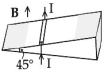
- 9As shown in the figure, a metallic rod of linear density $0.45\,kg\,m ^{-1}$ is lying horizontally on a smooth incline plane which makes an angle of $45^{\circ}$ with the horizontal. The minimum current flowing in the rod required to keep it stationary, when $0.15\,T$ magnetic field is acting on it in the vertical upward direction, will be $....A$ $\left\{\right.$ Use $\left.g=10 m / s ^{2}\right\}$View Solution
- 10The maximum current that can be measured by a galvanometer of resistance $40 \,\Omega$ is $10\, mA$. It is converted into a voltmeter that can read upto $50\, V$. The resistance to be connected in series with the galvanometer is ... (in $ohm$)View Solution