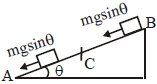
A small block starts slipping down from a point $B$ on an inclined plane $A B,$ which is making an angle $\theta$ with the horizontal section $BC$ is smooth and the remaining section $CA$ is rough with a coefficient of friction $\mu .$ It is found that the block comes to rest as it reaches the bottom (point $A)$ of the inclined plane. If $B C=2A C$, the coefficient of friction is given by $\mu=k \tan \theta$ .The value of $k$ is
JEE MAIN 2020, Diffcult


Download our appand get started for free
Experience the future of education. Simply download our apps or reach out to us for more information. Let's shape the future of learning together!No signup needed.*
Similar Questions
- 1A rod $(AB)$ is attached to a fixed point $(C)$ using a light rope $(AC)$. The other end of the rod $(B)$ is sitting on ice with negligible friction and the system is in stationary position. Which of the following can be the equilibrium configuration of this system?View Solution
- 2A $2 \mathrm{~kg}$ brick begins to slide over a surface which is inclined at an angle of $45^{\circ}$ with respect to horizontal axis. The co-efficient of static friction between their surfaces is:View Solution
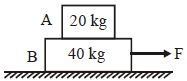
- 3In figure, the coefficient of friction between the floor and the block $B$ is $0.2$ and between blocks $A$ and $B$ is $0.3$. ........ $N$ is the maximum horizontal force $F$ can be applied to the block $B$ so that both blocks move together .View Solution
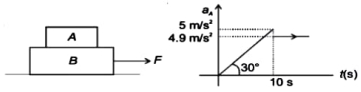
- 4Acceleration of block $A$ varies with time as shown in figure the value of coefficient of kinetic friction between block $A$ and $B$ is the value of coefficient of kinetic friction between block $A$ and $B$ is ..............View Solution
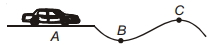
- 5View SolutionA vehicle is moving on a track with constant speed as shown in figure. The apparent weight of the vehicle is
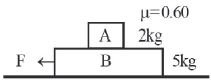
- 6Two block $(A)\,2\,kg$ and $(B)\,5\,kg$ rest one over the other on a smooth horizontal plane. The cofficient of static and dynamic friction between $(A)$ and $(B)$ is the same and equal to $0.60$. The maximum horizontal force that can be applied to $(B)$ in order that both $(A)$ and $(B)$ do not have any relative motion : $(g = 10\,m/s^2)$View Solution
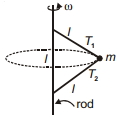
- 7In the figure, a ball of mass $m$ is tied with two strings of equal length as shown. If the rod is rotated with angular velocity $\omega$, thenView Solution
- 8A curved in a level road has a radius $75\, m$. The maximum speed of a car turning this curved road can be $30 \,m / s$ without skidding. If radius of curved road is changed to $48\, m$ and the coefficient of friction between the tyres and the road remains same, then maximum allowed speed would be .........$m / s$.View Solution
- 9In figure, two blocks $M$ and $m$ are tied together with an inextensible and light string. The mass $M$ is placed on a rough horizontal surface with coefficient of friction $\mu$ and the mass $m$ is hanging vertically against a smooth vertical wall. The pulley is frictionless. Choose the correct statement $(s)$View Solution

- 10A car is moving along a straight horizontal road with a speed ${v_0}$. If the coefficient of friction between the tyres and the road is $\mu $, the shortest distance in which the car can be stopped isView Solution