In figure, two blocks $M$ and $m$ are tied together with an inextensible and light string. The mass $M$ is placed on a rough horizontal surface with coefficient of friction $\mu$ and the mass $m$ is hanging vertically against a smooth vertical wall. The pulley is frictionless. Choose the correct statement $(s)$

Difficult
Download our app for free and get started
The friction force on the mass $M$ due to rough surface is $f=\mu M g$
In equilibrium,
For mass $m$
$T=m g$
for mass $M$
$f=\mu M g=T \Rightarrow$
$m g=\mu M g \Rightarrow m=\mu M$
If $m g>\mu M g,$ then there would be an acceleration.
Thus, we get $m>\mu M$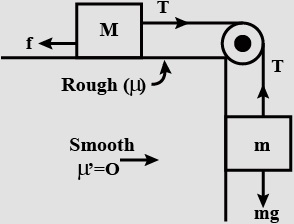

Download our appand get started for free
Experience the future of education. Simply download our apps or reach out to us for more information. Let's shape the future of learning together!No signup needed.*
Similar Questions
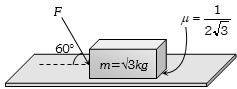
- 1What is the maximum value of the force $F$ such that the block shown in the arrangement, does not move ........ $N$View Solution
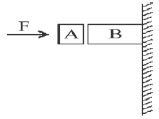
- 2Given in the figure are two blocks $A$ and $B$ of weight $20\ N$ and $100\ N,$ respectively. These are being pressed against a wall by a force $F$ as shown. If the coefficient of friction between the blocks is $0.1$ and between block $B$ and the wall is $0.15$, the frictional force applied by the wall on block $B$ is $......... N$View Solution
- 3A block is kept on an inclined plane of inclination $\theta$ of length l. The velocity of particle at the bottom of inclined is (the coefficient of friction is $\mu$)View Solution
- 4View SolutionA box is placed on an inclined plane and has to be pushed down. The angle of inclination is
- 5View SolutionMaximum force of friction is called
- 6The maximum tension which an inextensible ring of mass $0.1\, kg/m$ can bear is $10\,N$. The maximum velocity in $m/s$ with which it can be rotated is ........ $m/s.$View Solution
- 7Calculate the maximum acceleration (in $m s ^{-2}$) of a moving car so that a body lying on the floor of the car remains stationary. The coefficient of static friction between the body and the floor is $0.15$ $\left( g =10 m s ^{-2}\right)$.View Solution
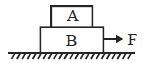
- 8In figure, the coefficient of friction between the floor and the block $B$ is $0.1$. The coefficient of friction between the blocks $B$ and $A$ is $0.2$. The mass of $A$ is $\frac{m}{2}$ and of $B$ is $m$. ........ $mg$ is the maximum horizontal force $F$ can be applied to the block $B$ so that two blocks move together ?View Solution
- 9A car has to move on a level turn of radius $450\,m.$ If the coefficient of static friction between tyre and the road is $\mu = 0.2.$ Find the maximum speed the car can take without skidding is given by ........ $m/s$View Solution
- 10A block of mass $4\, kg$ rests on an inclined plane. The inclination of the plane is gradually increased. it is found that when the inclination is $3$ in $5\left( {\sin \theta = \frac{3}{5}} \right)$, the block just begins to slide down the plane. The coefficient of friction between the block and the plane isView Solution