Question
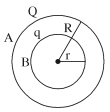
A small conducting sphere (radius r ) is placed concentrically inside a larger conducting hollow sphere of radius $R$. The big and small spheres are charged with $Q$ and $q(Q>q)$ respectively and kept separate from each other. Calculate the potential difference between the spheres.
Answer

Potential on the surface of A due to Q $ V=\frac{1}{4 \pi \in_0} \times \frac{Q}{R} $
Potential on the surface of A due to $q$
Image
$ V=\frac{1}{4 \pi \in_0} \times \frac{q}{R} $
Potential on the surface of $B$ due to $Q=\frac{1}{4 \pi \in_0} \times \frac{Q}{R}$
Potential on the surface of B due to $q=\frac{1}{4 \pi \in_0} \times \frac{q}{r}$
$\therefore$ Potential at $A , B _{s l}=\frac{1}{4 \pi \in_0}\left(\frac{ Q }{ R }+\frac{q}{ R }\right)$
Potential at $B , V _{ B }=\frac{1}{4 \pi \in_0}\left(\frac{ Q }{ R }+\frac{q}{r}\right)$
$\therefore \quad V _{ B }- V _{ A }=\frac{1}{4 \pi \in_0}\left(\frac{q}{r}-\frac{q}{ R }\right)$

Need a full question paper?

Generate a complete, print-ready paper with questions like this in minutes — across 16+ boards, with answer keys.

Start Generating Free

Similar questions

The conductivity of a pure semiconductor is roughly proportional to $\text{T}^\frac{3}{2}\text{e}^{\frac{-\Delta\text{E}}{2\text{kT}}}$ where $\Delta\text{E}$ is the band gap. The band gap for germanium is 0.74eV at 4K and 0.67eV at 300K. By what factor does the conductivity of pure germanium increase as the temperature is raised from 4K to 300K?
A vessel contains water upto a height of 20cm and above it an oil upto another 20cm. The refractive indices of the water and the oil are 1.33 and 1.30 respectively. Find the apparent depth of the vessel when viewed from above.
  1. Name two important processes that occur during the formation of a pn junction.
  2. Draw the circuit diagram of a full wave rectifier along with the input and output waveforms. Briefly, explain how the output voltage/current is unidirectional.
$\text{ }^{197}_{80}\text{Hg}$ decay to $\text{ }^{197}_{79}\text{Au}$ through electron capture with a decay constant of 0.257 per day.
  1. What other particle or particles are emitted in the decay?
  2. Assume that the electron is captured from the K shell. Use Moseley's law $\sqrt{\text{v}}=\text{a(Z}-\text{b})$ with $\text{a}=4.95\times10^7\text{s}^{-\frac{1}{2}}$ and b = 1 to find the wavelength of the $\text{K}_{\alpha}$ X-ray emitted following the electron capture.
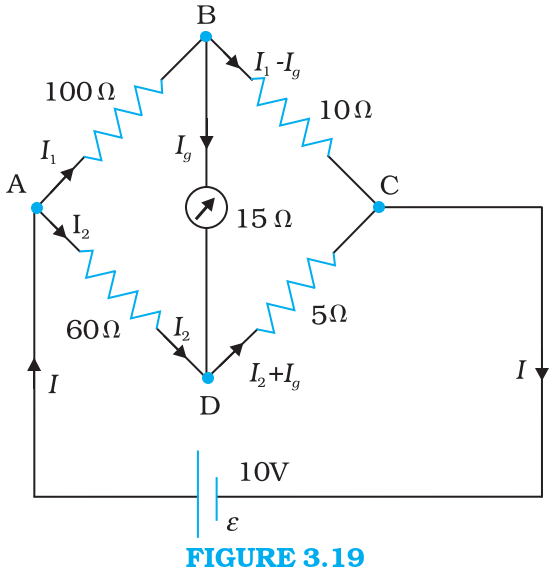
The four arms of a Wheatstone bridge (Fig. 3.19) have the following resistances:
$
AB =100 \Omega, BC =10 \Omega, CD =5 \Omega \text {, and } DA =60 \Omega \text {. }
$
Image
A galvanometer of $15 \Omega$ resistance is connected across BD. Calculate the current through the galvanometer when a potential difference of $10 V$ is maintained across AC.
A parallel-plate capacitor of plate-area A and plate separation d is joined to a battery of emf $\in$ and internal resistance R at t = 0. Consider a plane surface of area $\frac{\text{A}}{2}$ parallel to the plates and situated symmetrically between them. Find the displacement current through this surface as a function of time.
The. wire ABC shown in figure forms an equilateral triangle. Find the magnetic field B at the centre O of the triangle assuming the wire to be uniform.

What is the de Broglie wavelength associated with (a) an electron moving with a speed of $5.4 \times 10^6 m / s$, and (b) a ball of mass $150 g$ travelling at $30.0 m / s$ ?
A railway track (made of iron) is laid in winter when the average temperature is 18°C. The track consists of sections of 12.0m placed one after the other. How much pp should be left between two such sections 80 that there is no compression during summer when the maximum temperature goes to 48°C? Coefficient of linear expansion of iron = 11 × 10-6 °C-1.
Define the current sensitivity of a galvanometer. Write its S.I. unit.
Figure shows two circuits each having a galvanometer and a battery of 3 V. When the galvanometers in each arrangement do not show any deflection, obtain the ratio R/ R2.