Question
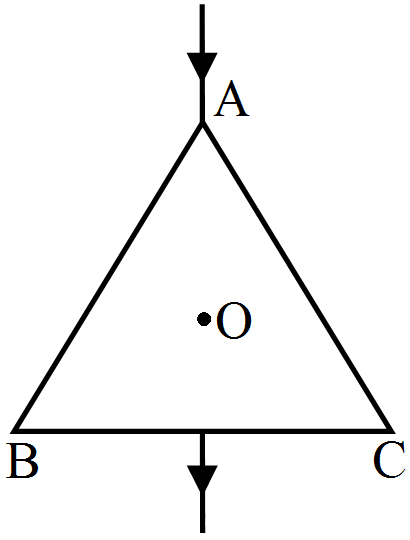
The. wire ABC shown in figure forms an equilateral triangle. Find the magnetic field B at the centre O of the triangle assuming the wire to be uniform.
Answer


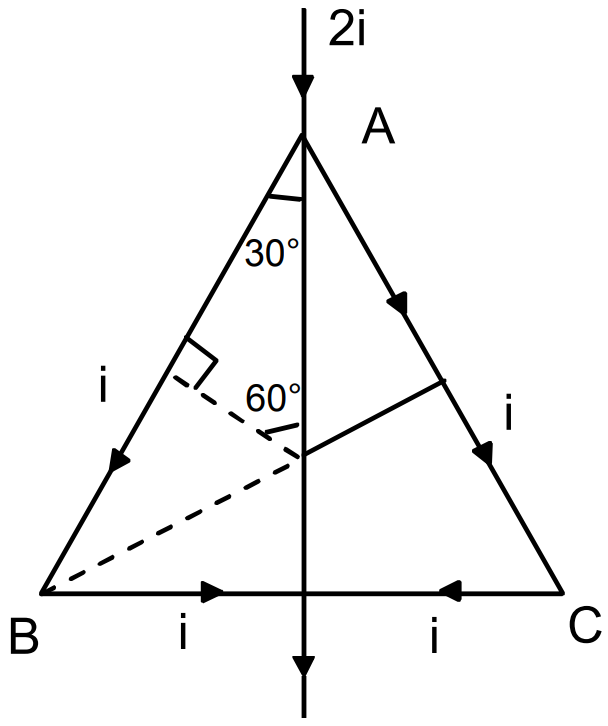
For AB B is along $\odot\ \text{B}=\frac{\mu_0\text{i}}{4\pi\text{r}}(\sin60^\circ+\sin60^\circ)$

For AC B $\otimes\ \text{B}=\frac{\mu_0\text{i}}{4\pi\text{r}}(\sin60^\circ+\sin60^\circ)$

For BD B $\odot\ \text{B}=\frac{\mu_0\text{i}}{4\pi\text{r}}(\sin60^\circ)$

For DC $\otimes\ \text{B}=\frac{\mu_0\text{i}}{4\pi\text{r}}(\sin60^\circ)$

$\therefore\ \text{Net}\ \text{B}=0$

Need a full question paper?

Generate a complete, print-ready paper with questions like this in minutes — across 16+ boards, with answer keys.
Start Generating Free

Similar questions

Current of 4 A is flowing in a straight wire AB. A proton $P$ is travelling parallel to the wire in the opposite direction of current with a speed of $4 \times 10^6$ $m / s$ at a distance of 0.2 m from the wire as shown in the diagram. Calculate the magnitude of force applied on the proton and also tells its direction.
  1. Define mutual inductance.
  2. A pair of adjacent coils has a mutual inductance of 1.5 H. If the current in one coil changes from 0 to 20 A in 0.5 s, what is the change of flux linkage with the other coil?
If each diode in Fig. has a forward bias resistance of 25Ω and infinite resistance in reverse bias, what will be the values of the current I1, I2, I3 and I4?

  1. Name two important processes that occur during the formation of a pn junction.
  2. Draw the circuit diagram of a full wave rectifier along with the input and output waveforms. Briefly, explain how the output voltage/current is unidirectional.
  1. Six lead-acid type of secondary cells each of emf 2.0 V and internal resistance $0.015\Omega$ are joined in series to provide a supply to a resistance of $8.5\ \Omega.$ What are the current drawn from the supply and its terminal voltage?
  2. A secondary cell after long use has an emf of 1.9 V and a large internal resistance of $380\ \Omega$ What maximum current can be drawn from the cell? Could the cell drive the starting motor of a car?
A concave mirror of radius R is kept on a horizontal. Water $\big($refractive index $=\mu\big)$ is poured into it upto a height h. Where should an object be placed so that its image is formed on itself?

Sketch a graph between frequency of incident radiations and stopping potential for a given photosensitive material. What information can be obtained from the value of the intercept on the potential axis? A source of light of frequency greater than the threshold frequency is placed at a distance of 1 m from the cathode of a photo-cell. The stopping potential is found to be V. If the distance of the light source from the cathode is reduced, explain giving reasons, what change will you observe in the.
  1. photoelectric current,
  2. stopping potential.
Explain the effect of frequency of incident radiation on stopping potential.
Calculate the ratio of energies of photons produced due to transition of electron of hydrogen atom from its;
  1. Second permitted energy level to the first level.
  2. Highest permitted energy level to the second permitted level.
Water is boiled in a container having a bottom of surface area 25cm2, thickness 1.0mm and thermal conductivity $50\text{wm}^{-1}{^{\circ}}\text{C}^{-1}.$ 100g of water is converted into steam per minute in the steady state after the boiling starts. Assuming that no heat is lost to the atmosphere, calculate the temperature of the lower surface of the bottom. Latent heat of vaporization of water $=0.26\times10^6\text{Jkg}^{-1}.$