A small drop of water falls from rest through a large height $h$ in air; the final velocity is
Easy
Download our app for free and get started
(d) The terminal velocity is independent of the height of launch.

Download our appand get started for free
Experience the future of education. Simply download our apps or reach out to us for more information. Let's shape the future of learning together!No signup needed.*
Similar Questions
- 1A load of mass $M\,kg$ is suspended from a steel wire of length $2\,m$ and radius $1.0\,mm$ in Searle’s apparatus experiment. The increase in length produced in the wire is $4.0\,mm.$ Now the load is fully immersed in a liquid of relative density $2$. The relative density of the material of load is $8$. The new value of increase in length of the steel wire is ........ $mm$View Solution
- 2Consider two solid spheres $\mathrm{P}$ and $\mathrm{Q}$ each of density $8 \mathrm{gm} \mathrm{cm}^{-3}$ and diameters $1 \mathrm{~cm}$ and $0.5 \mathrm{~cm}$, respectively. Sphere $\mathrm{P}$ is dropped into a liquid of density $0.8 \mathrm{gm} \mathrm{cm}^{-3}$ and viscosity $\eta=3$ poiseulles. Sphere $Q$ is dropped into a liquid of density $1.6 \mathrm{gm} \mathrm{cm}^{-3}$ and viscosity $\eta=2$ poiseulles. The ratio of the terminal velocities of $\mathrm{P}$ and $\mathrm{Q}$ isView Solution
- 3A vessel contains oil (density =$ 0.8 \;gm/cm^3$) over mercury (density = $13.6\; gm/cm^3$). A homogeneous sphere floats with half of its volume immersed in mercury and the other half in oil. The density of the material of the sphere in $ gm/cm^3$ isView Solution
- 4Water flows into a cylindrical vessel of large cross-sectional area at a rate of $10^{-4}$ $m^3/s$. It flows out from a hole of area $10^{-4}$ $m^2$, which has been punched through the base. How high does the water rise in the vessel?View Solution
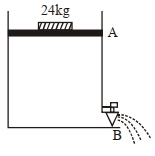
- 5Consider a water tank as shown in the figure. It's cross-sectional area is $0.4\, m ^{2}$. The tank has an opening $B$ near the bottom whose cross-section area is $1\, cm ^{2}$. A load of $24\, kg$ is applied on the water at the top when the height of the water level is $40\, cm$ above the bottom, the velocity of water coming out the opening $B$ is $v\, ms ^{-1}$. The value of $v$, to the nearest integer, is ......$m/s$. [Take value of $g$ to be $10 \,ms ^{-2}$ ]View Solution
- 6$A U-$ tube having horizontal arm of length $20$ $cm$, has uniform cross-sectional area $=1\ cm^2$. It is filled with water of volume $60$ $cc$. What volume of a liquid of density $4$ $g/cc$ should be poured from one side into the $U -$ tube so that no water is left in the horizontal arm of the tube ........ $cc$ ?View Solution
- 7Water is flowing on a horizontal fixed surface, such that its flow velocity varies with $y$ (vertical direction) as $v=k\left(\frac{2 y^2}{a^2}-\frac{y^3}{a^3}\right)$. If coefficient of viscosity for water is $\eta$, what will be shear stress between layers of water at $y=a$.View Solution
- 8A cylindrical vessel of cross-section $A$ contains water to a height $h$ . There is a hole in the bottom of radius $'a'$ . The time in which it will be emptied isView Solution
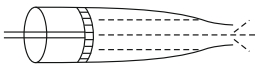
- 9Figure below shows a liquid being pushed out of the tube by a piston having area of cross section $2.0\,cm ^2$. The area of cross section at the outlet is $10\,mm ^2$. If the piston is pushed at a speed of $4\,cm s ^{-1}$, the speed of outgoing fluidis $.........\,cm s ^{-1}$.View Solution
- 10A bucket contains water filled upto a height $=$ $15 cm$. The bucket is tied to a rope which is passed over a frictionless light pulley and the other end of the rope is tied to a weight of mass which is half of that of the (bucket $+$ water). The water pressure above atmosphere pressure at the bottom is ....... $kPa$View Solution