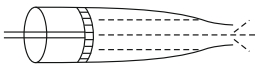
Figure below shows a liquid being pushed out of the tube by a piston having area of cross section $2.0\,cm ^2$. The area of cross section at the outlet is $10\,mm ^2$. If the piston is pushed at a speed of $4\,cm s ^{-1}$, the speed of outgoing fluidis $.........\,cm s ^{-1}$.
JEE MAIN 2023, Easy
Download our app for free and get started
By equation of continuity
$A _1 V _1= A _2 V _2$
$V _2=\frac{2 \times 4}{10 \times 10^{-2}}=80\,cm / s$

Download our appand get started for free
Experience the future of education. Simply download our apps or reach out to us for more information. Let's shape the future of learning together!No signup needed.*
Similar Questions
- 1Three liquids of densities $d,\,2d$ and $3d$ are mixed in equal volumes. Then the density of the mixture isView Solution
- 2A metallic body of material with density of $8000\ kg/m^3$ has a cavity inside. A spring balance shows its mass to be $10.0\ kg$ in air and $7.5\ kg$ when immersed in water. The ratio of the volume of the cavity to the volume of the material of the body must beView Solution
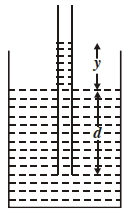
- 3A drinking straw is dipped in a pan of water to depth d from the surface (see figure below). Now water is sucked into it up to an initial height $h_0$ and then left to oscillate. As a result, its height $y$ from the surface of the water varies periodically. Ignoring damping, the equation for $y$ is ( $g$ is the acceleration due to gravity):View Solution
- 4A river $10\,m$ deep is flowing at $5\,m/s$. The shearing stress between horizontal layers of the river is :- $(\eta = 10^{-3}\,SI\,unit)$View Solution
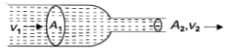
- 5A liquid flows in the tube from left to right as shown in figure. $A_1$ and $A_2$ are the cross-sections of the portions of the tube as shown. The ratio of speed $\frac{v_1}{v_2}$ will be ..........View Solution
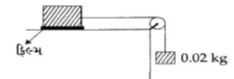
- 6A metal block of base area $0.2\; m ^{2}$ is connected to a $0.02\; kg$ mass via a string that passes over an ideal pulley as shown in figure. A liquid film of thickness $0.6\; mm$ is placed between the block and the table. When released the block moves to the right with a constant speed of $0.17\; m / s$. The co-efficient of viscosity of the liquid isView Solution
- 7Consider the wall of a dam to be straight with height $H$ and length $L$. It holds a lake of water of height $h (h < H)$ on one side. Let the density of water be $\rho_{ w }$. Denote the torque about the axis along the bottom length of the wall by $\tau_1$. Denote also a similar torque due to the water up to height $h / 2$ and wall length $L / 2$ by $\tau_2$. Then $\tau_1 / \tau_2$ (ignore atmospheric pressure) isView Solution
- 8What is the pressure on a swimmer $20 \,m$ below the surface of water ........ $atm$View Solution
- 9Water is moving with a speed of $5.18 ms^{-1}$ through a pipe with a cross-sectional area of $4.20 cm^2$. The water gradually descends $ 9.66 m $ as the pipe increase in area to $7.60 cm^2$. The speed of flow at the lower level is ....... $ms^{-1}$View Solution
- 10Two cylindrical vessels of equal cross-sectional area $16\,cm ^{2}$ contain water upto herghts $100\,cm$ and $150\,cm$ respectively. The vessels are interconnected so that the water levels in them become equal. The work done by the force of gravity during the process, is $......J$ [Take density of water $=10^{3}\,kg / m ^{3}$ and $g =10\,ms ^{-2}$ ]View Solution