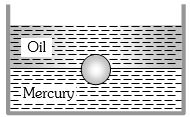
A vessel contains oil (density =$ 0.8 \;gm/cm^3$) over mercury (density = $13.6\; gm/cm^3$). A homogeneous sphere floats with half of its volume immersed in mercury and the other half in oil. The density of the material of the sphere in $ gm/cm^3$ is
IIT 1998, Diffcult
Download our app for free and get started
(c)As the sphere floats in the liquid. Therefore its weight will be equal to the upthrust force on it
Weight of sphere
$ = \frac{4}{3}\pi {R^3}\rho g$ …(i) ...... (i)
Upthrust due to oil and mercury
$ = \frac{2}{3}\pi {R^3} \times {\sigma _{oil}}g + \frac{2}{3}\pi {R^3}{\sigma _{Hg}}g$ …(ii)
Equating (i) and (ii)
$\frac{4}{3}\pi {R^3}\rho g = \frac{2}{3}\pi {R^3}0.8g + \frac{2}{3}\pi {R^3} \times 13.6g$$ \Rightarrow 2\rho = 0.8 + 13.6 = 14.4 \Rightarrow \rho = 7.2$
Weight of sphere
$ = \frac{4}{3}\pi {R^3}\rho g$ …(i) ...... (i)
Upthrust due to oil and mercury
$ = \frac{2}{3}\pi {R^3} \times {\sigma _{oil}}g + \frac{2}{3}\pi {R^3}{\sigma _{Hg}}g$ …(ii)
Equating (i) and (ii)
$\frac{4}{3}\pi {R^3}\rho g = \frac{2}{3}\pi {R^3}0.8g + \frac{2}{3}\pi {R^3} \times 13.6g$$ \Rightarrow 2\rho = 0.8 + 13.6 = 14.4 \Rightarrow \rho = 7.2$

Download our appand get started for free
Experience the future of education. Simply download our apps or reach out to us for more information. Let's shape the future of learning together!No signup needed.*
Similar Questions
- 1Two bodies are in equilibrium when suspended in water from the arms of a balance. The mass of one body is $36 g $ and its density is $9 g / cm^3$. If the mass of the other is $48 g$, its density in $g / cm^3$ isView Solution
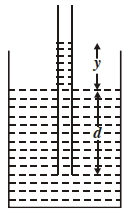
- 2A drinking straw is dipped in a pan of water to depth d from the surface (see figure below). Now water is sucked into it up to an initial height $h_0$ and then left to oscillate. As a result, its height $y$ from the surface of the water varies periodically. Ignoring damping, the equation for $y$ is ( $g$ is the acceleration due to gravity):View Solution
- 3According to Bernoulli's equation $\frac{P}{{\rho g}} + h + \frac{1}{2}\,\frac{{{v^2}}}{g} = {\rm{constant}}$ The terms $A, B$ and $ C$ are generally called respectively:View Solution
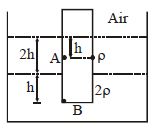
- 4A cylinder stands vertical in two immiscible liquids of densities $\rho$ and $2 \rho$. The height of two liquids are shown. Find the difference in pressure at point $A$ and $B$View Solution
- 5Two identical cylindrical vessels with their bases at same level, each contains a liquid of density $d$ . The height of the liquid in one vessel is $ h_1$ and that in the other vessel is $h_2$ . The area of either base is $A$ . The work done by gravity in equalizing the levels when the two vessels are connected isView Solution
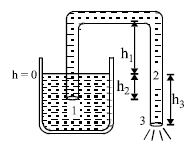
- 6Figure shows a siphon. Choose the wrong statement : ( $P_0 =$ atmospheric pressure)View Solution
- 7Alarge tank is filled with water to a height $H$.A small hole is made at the base of the tank. It takes $T_1$ time to decrease the height of water to $H/ \eta , (\eta > 1)$ and it takes $T_2$ time to take out the rest of water. If $T_1 = T_2$ , then the value of $\eta$ is :View Solution
- 8View SolutionWater falls from a tap, down the streamline
- 9A plane is in level flight at constant speed and each of its two wings has an area of $40 \mathrm{~m}^2$. If the speed of the air is $180 \mathrm{~km} / \mathrm{h}$ over the lower wing surface and $252 \mathrm{~km} / \mathrm{h}$ over the upper wing surface, the mass of the plane is______ $\mathrm{kg}$. (Take air density to be $1 \mathrm{~kg} \mathrm{~m}^{-3}$ and $\mathrm{g}=10 \mathrm{~ms}^{-2}$ )View Solution
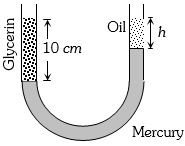
- 10A vertical $U-$ tube of uniform inner cross section contains mercury in both sides of its arms. A glycerin (density = $1.3 g/cm^3$) column of length $10 $ $cm $ is introduced into one of its arms. Oil of density $0.8 gm/cm^3$ is poured into the other arm until the upper surfaces of the oil and glycerin are in the same horizontal level. Find the length of the oil column ........ $cm$. Density of mercury = $13.6 g/cm^3$View Solution