MCQ
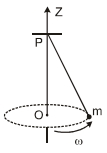
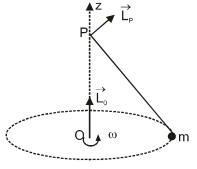
A small mass $m$ is attached to a massless string whose other end is fixed at $P$ as shown in the figure. The mass is undergoing circular motion is the $x-y$ plane with centre at $O$ and constant angular speed $\omega$. If the angular momentum of the system, calculated about $O$ and $P$ are denoted by $\vec{L}_O$ and $\vec{L}_P$ respectively, then
  • A
    $\overrightarrow{ L }_{ O }$ and $\overrightarrow{ L }_{ P }$ do not vary with time.
  • B
    $\vec{L}_0$ varies with time while $\vec{L}_P$ remains constant.
  • $\vec{L}_O$ remains constant while $\vec{L}_P$ varies with time.
  • D
    $\vec{L}_0$ and $\vec{L}_P$ both vary with time.
Answer

Correct option: C.
$\vec{L}_O$ remains constant while $\vec{L}_P$ varies with time.
c

Need a full question paper?

Generate a complete, print-ready paper with questions like this in minutes — across 16+ boards, with answer keys.

Start Generating Free

Similar questions

A spring block system in horizontal oscillation has a time-period $T$. Now the spring is cut into four equal parts and the block is re-connected with one of the parts. The new time period of vertical oscillation will be
The change in potential energy, when a body of mass $m$ is raised to a height $nR$ from the earth's surface is ($R =$ Radius of earth)
Energy evolved in a chemical reaction:
A bullet from a gun is fired on a rectangular wooden block with velocity $u$.When bullet travels $24\,cm$ through the block along its length horizontally, velocity of bullet becomes $\frac{u}{3}$. Then it further penetrates into the block in the same direction before coming to rest exactly at the other end of the block. The total length of the block is $........\,cm$
A thin rod of mass $0.9\, kg$ and length $1 \,m$ is suspended, at rest, from one end so that it can freely oscillate in the vertical plane. A particle of move $0.1\, kg$ moving in a straight line with velocity $80\,m / s$ hits the rod at its bottom most point and sticks to it (see figure). The angular speed (in $rad/s$) of the rod immediately after the collision will be
Four spheres $A, B, C$ and $D$ are of same radius but made of different metals. Their densities are in ratio $6 : 3 : 4 : 5$ and specific heats are in ratio $2 : 5 : 4 : 6$ . These are initially kept at the same temperature and placed in the same surroundings. The sphere which has the slowest rate of cooling is
A swimmer wants to cross a river from point $A$ to point $B$. Line $A B$ makes an angle of $30^{\circ}$ with the flow of river. Magnitude of velocity of the swimmer is same as that of the river. The angle $\theta$ with the line ${AB}$ should be $^{\circ}$, so that the swimmer reaches point ${B}$.
The following four wires of length $L$ and radius $r$ are made of the same material. Which of these will have the largest extension, when the same tension is applied?
Which one of the following statements is correct?
In the given diagram, one graph is of an ideal gas and another is of a real gas. Select the correct option.