MCQ
Energy evolved in a chemical reaction:
  • A
    Conversion of mass into energy.
  • Conversion of bond energy into heat energy.
  • C
    Both $(a)$ and $(b).$
  • D
    Neither $(a)$ nor $(b).$

Answer

Correct option: B.
Conversion of bond energy into heat energy.
A chemical reaction is basically a re$-$arrangement of atoms among different molecules.
When there is change in bond energy or binding energy, the balance energy may be absorbed or released.
So, energy evolved in a chemical reaction comes from bond energy.

Need a full question paper?

Generate a complete, print-ready paper with questions like this in minutes — across 16+ boards, with answer keys.
Start Generating Free

Similar questions

Choose the fundamental forces from the options given below:
Let $\overrightarrow{\text{A}}$ be a unit vector along the axis of rotation of a purely rotating body and $\overrightarrow{\text{B}}$ be a unit vector along the velocity of a particle $P$ of the body away from the axis. The value of $\overrightarrow{\text{A}}.\overrightarrow{\text{B}}$ is:
The dimension of $\frac{1}{{\sqrt {{\varepsilon _0}{\mu _0}} }}$ is that of
$4$ moles of an ideal gas is at $0°C.$ At constant pressure it is heated to double its volume, then its final temperature will be ...... $^oC$
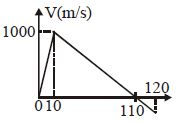
The graph shows the variation of velocity of a rocket with time. Then, the maximum height attained by the rocket is ...........$km$ :-
A solid sphere (mass $2\ M$) and a thin hollow spherical shell (mass $M$) both of the same size, roll down an inclined plane, then
An astronaut takes a ball of mass $m$ from earth to space. He throws the ball into a circular orbit about earth at an altitude of $318.5 \mathrm{~km}$. From earth's surface to the orbit, the change in total mechanical energy of the ball is $x \frac{\mathrm{GM}_e \mathrm{~m}}{21 R_e}$. The value of $x$ is (take $R_{\mathrm{e}}=6370 \mathrm{~km}$ ):
The equation of $SHM$ is given as:

$x = 3\,sin\, 20\pi t + 4\, cos\, 20\pi t$ , 

where $x$ is in $cms$ and $t$ is in $seconds$ . The amplitude is  ..... $cm$

A bar magnet is moved along the axis of a copper ring placed far away from the magnet, Looking from the side of the magnet an anticlockwise current is found to be induced in the ring. Which of the following may be true?
Which one of the following statements is not true about the motion of a projectile?