MCQ
A smooth sphere $A$ is moving on a frictionless horizontal plane with angular speed $\omega $ and center of mass with velocity $v$. It collides elastically and head-on with an identical sphere $B$ at rest. Neglect friction everywhere. After the collision, their angular speeds are ${\omega _A}$ and ${\omega _B}$ respectively. Then
  • A
    ${\omega _A} < {\omega _B}$
  • B
    ${\omega _A} = {\omega _B}$
  • ${\omega _A} = \omega $
  • D
    $\omega = {\omega _B}$

Answer

Correct option: C.
${\omega _A} = \omega $
c
As the spheres are smooth there will be no friction (no torque) and therefore there will be no transfer of angular momentum. Thus $\mathrm{A}$, after collision will remain with its intial angular momentum $i . e ., \omega_{A}=\omega$

Need a full question paper?

Generate a complete, print-ready paper with questions like this in minutes — across 16+ boards, with answer keys.

Start Generating Free

Similar questions

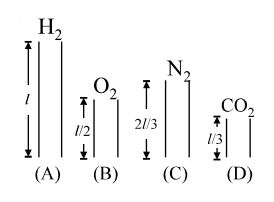
Four open organ pipes of different lengths and different gases at same temperature as shown in figure. Let $f_A$, $f_B$, $f_C$ and $f_D$ be their fundamental frequencies then :[Take ${\gamma _{c{o_2}}} = 7/5$]
The displacement of a particle is represented by the equation : $\text{y}=3\cos\Big(\frac{\pi}{4}-2\omega\text{t}\Big)$
The motion of the particle is:
In an isobaric expansion of an ideal gas, which of the following is zero?
Mercury thermometers can be used to measure temperatures upto ........ $^oC$
The number of significant figures in the measured value $4.700 \,m$ is the same as that in the value ....... $m$
The component of vector $A = 2\hat i + 3\hat j$ along the vector $\hat i + \hat j$is
$Assertion :$ Two thin blankets put together are warmer than a single blanket of double the thickness.
$Reason :$ Thickness increases because of air layer enclosed between the two blankets.
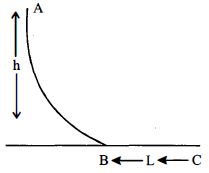
A small ball of mass $m$ starts at a point $A$ with speed $v_0$ and moves along a frictionless track $AB$ as shown. The track $BC$ has coefficient of friction $\mu $. The ball comes to stop at $C$ after travelling a distance $L$ which is
A block $A$ of mass $m_1$ rests on a horizontal table. A light string connected to it passes over a frictionless pully at the edge of table and from its other end another block $B$ of mass $m_2$ is suspended. The coefficient of kinetic friction between the block and the table is $\mu _k.$ When the block $A$ is sliding on the table, the tension in the string is
The dimensional formula for $r.m.s.$ (root mean square) velocity is