MCQ
$A$ smooth sphere is moving on a horizontal surface with a velocity vector $(\,2\,\hat i + 2\,\hat j\,)$ $m/s$ immediately before it hit a vertical wall. The wall is parallel to vector $\hat j$ and coefficient of restitution between the sphere and the wall is $e = 1/2$ . The velocity of the sphere after it hits the wall is
  • A
    $\,\hat i - \,\hat j$
  • $ - \,\hat i + 2\,\hat j$
  • C
    $ - \,\hat i - \,\hat j$
  • D
    $2\,\hat i - \,\hat j$

Answer

Correct option: B.
$ - \,\hat i + 2\,\hat j$
b
Initial velocity of the sphere $u=2 \hat{i}+2 \hat{j}$ As the wall is parallel to $y$ axis, thus its velocity componant in $y$ direction remains the same i.e $2 \hat{j}$ but its velocity componant in $x$ direction changes.

Newtons law of collision in $x$ direction: $\quad \frac{-v^{\prime}-0}{v-0}=-e$

$\frac{v^{\prime}-0}{2 \hat{i}-0}=-\frac{1}{2} \quad \Longrightarrow \quad v^{\prime}=-\hat{i}$

$\Longrightarrow$ velocity vector of sphere after hitting the wall $\quad u^{\prime}=-\hat{i}+2 \hat{j}$

Need a full question paper?

Generate a complete, print-ready paper with questions like this in minutes — across 16+ boards, with answer keys.

Start Generating Free

Similar questions

A man throws balls with the same speed vertically upwards one after the other at an interval of $2$ second. What should be the speed of the throw so that more than two balls are in sky at any time? $($Given $g = 9.8\ m/ s^2)$
A stone is thrown with an initial speed of $4.9 \,m/s$ from a bridge in vertically upward direction. It falls down in water after $2 \,sec$. The height of the bridge is..........$m$
A stone ties to the end of a string $1\,m$ long is whirled in a horizontal circle with a constant speed. If the stone makes $22$ revolution in $44$ seconds, what is the magnitude and direction of acceleration of the stone
From the top of a tower of height $40\, m$, a ball is projected upwards with a speed of $20\, m/s$ at an angle $30^o$ to the horizontal. The ball will hit the ground in time ......... $\sec$ (Take $g = 10\, m/s^2$)
A diatomic gas undergoes a process represented by $PV ^{1.3}=$ constant. Choose the incorrect statement
The ratio of the weights of a body on the Earth's surface to that on the surface of a planet is $9 : 4$. The mass of the planet is $\frac{1}{9}^{th}$ of that of the Earth. If $'R'$ is the radius of the Earth, what is the radius of the planet ? (Take the planets to have the same mass density)
A stone is released with acceleration $'a'$ from an upwardy moving left. Find out the acceleration and direction of the stone.
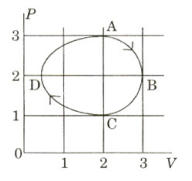
The figure shows the $P-V$ plot of an ideal gas taken through a cycle $ABCDA$. The part $ABC$ is a semi-circle and $CDA$ is half of an ellipse. Then,

$(A)$ the process during the path $\mathrm{A} \rightarrow \mathrm{B}$ is isothermal

$(B)$ heat flows out of the gas during the path $\mathrm{B} \rightarrow \mathrm{C} \rightarrow \mathrm{D}$

$(C)$ work done during the path $\mathrm{A} \rightarrow \mathrm{B} \rightarrow \mathrm{C}$ is zero

$(D)$ positive work is done by the gas in the cycle $ABCDA$

A spring balance and a physical balance are kept in a lift. In these balances equal masses are placed. If now the lift starts moving upwards with constant acceleration, then
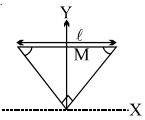
The figure shows an isosceles triangular plate of mass $M$ and base $L$. The angle at the apex is $90^o$. The apex lies at the origin and the base is parallel to $X$ -axis The moment of inertia of the plate about the $z$ -axis is